
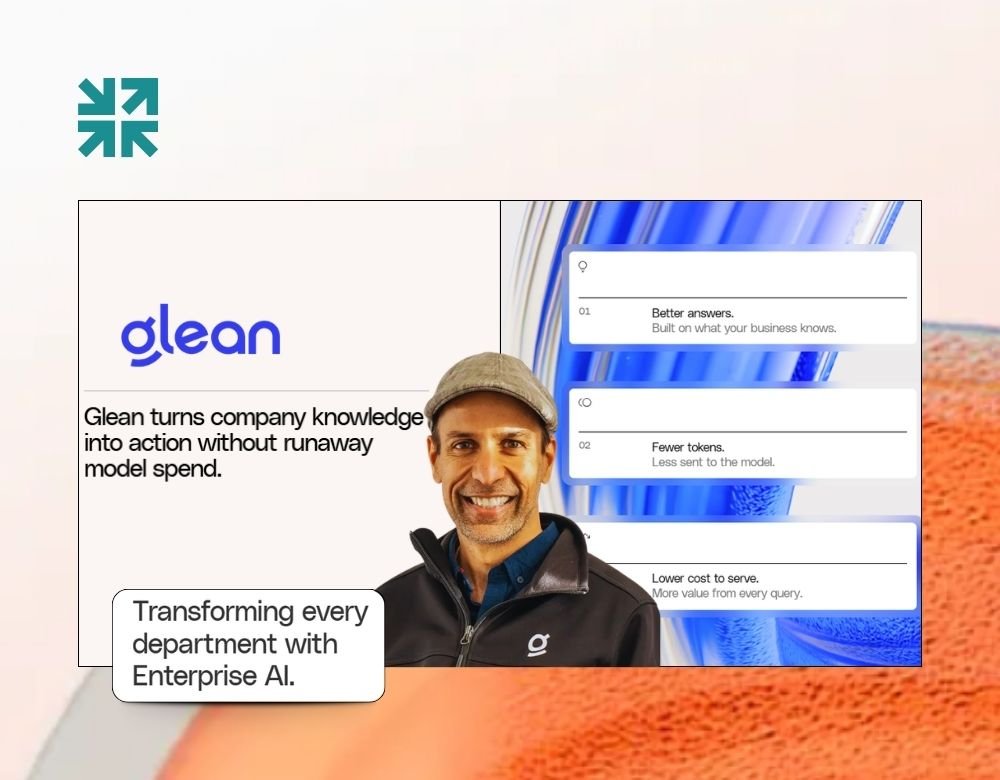
Glean began with a problem that existed long before generative AI became part of the enterprise software conversation: companies had too much information and too many places to store it. Employees were working across cloud drives, communication platforms, CRM systems, project-management software, internal knowledge bases and countless other applications. Finding information was often less about whether the information existed and more about knowing where to look for it. Founded in 2019 by Arvind Jain, Glean entered this market by building enterprise search around the way organisations actually stored and accessed knowledge. Over time, that starting point has given the company a broader opportunity. Search is now becoming one component of a platform designed to understand company information, assist employees and increasingly execute work across enterprise systems.
Search Was the Starting Point
Glean’s initial proposition was relatively straightforward. Instead of forcing employees to search separately across every application used by their organisation, the company connected information from multiple enterprise systems and created a unified search experience. The underlying challenge, however, was more complicated than simply indexing documents. Enterprise information has context. A document may be relevant to one employee but inaccessible to another. A customer record may connect to a sales opportunity, an internal discussion and a product document. A company policy may have several versions, with only one being current. Glean’s product therefore had to understand not only where information was located, but also how it related to people, teams and business systems.
That became an important foundation for what followed. By creating connections between enterprise applications, Glean was building a layer of organisational context at a time when most enterprise software remained organised around individual applications.
AI Changed What Search Could Do
The arrival of generative AI created a new use case for that underlying infrastructure. Traditional search could locate relevant information, but generative AI could interpret it and produce an answer. Glean introduced its AI Assistant to bring this interaction into the workplace, allowing employees to ask questions using natural language and receive responses based on information available within their organisation.
The distinction between Glean and a general-purpose AI chatbot lies largely in the source of the information. A general AI model can answer questions about publicly available knowledge, but it does not inherently understand a company’s internal product roadmap, customer relationships, policies, documents or organisational structure. Glean’s proposition is based on connecting AI to that internal context while respecting enterprise permissions. The result is intended to make company knowledge accessible through a conversational interface without treating the organisation’s information as one undifferentiated database.
This also gave Glean a new way to expand beyond search. Once employees could ask the system questions about company information, the same infrastructure could support content creation, analysis and other forms of knowledge work.
The Enterprise Data Layer Became More Important
The scale of Glean’s connected information has grown alongside the product. By December 2025, the company said its platform had indexed more than 27 billion documents and connected with more than 100 enterprise SaaS applications. The significance of these numbers is not simply the volume of information being indexed. It is the breadth of the organisational context that can potentially be made available to the platform.
For enterprise AI, context is becoming an important part of the product architecture. A model may provide the reasoning capability, but the usefulness of that model inside a company depends on what information it can access, what the employee is allowed to see and how that information connects to the business. Glean is attempting to occupy this layer between the company’s existing software systems and the AI models that can operate on top of them.
That positioning also gives the company some distance from the underlying model race. The leading AI models are changing quickly, and enterprises may use different models for different workloads. Glean’s role is not necessarily to own the model itself. Its role is to connect models to enterprise context, information and workflows.
From Answering Questions to Executing Work
The next step was to move beyond providing answers. In 2025, Glean expanded into AI agents, allowing organisations to create systems that can perform multi-step tasks across connected applications. This changes the role of the platform from information retrieval toward workflow execution.
The distinction is important. Search helps an employee find something. An assistant helps the employee understand something. An agent can potentially take the next action.
Consider a sales organisation. An employee might ask for the latest information about a customer. A search system can locate the relevant documents. An AI assistant can summarise the account and identify important developments. An agent could potentially use that information to update systems, prepare a response or initiate a workflow. Each stage builds on the same underlying access to organisational information.
Glean said in June 2025 that its platform was already supporting more than 100 million agent actions annually, indicating that agent activity was becoming a measurable component of usage rather than simply an experimental feature.
Glean Is Expanding Horizontally
One of the more important aspects of Glean’s strategy is that it has not confined the product to a single business function. The platform is designed to work across departments, including sales, engineering, human resources, finance, customer service and other knowledge-intensive functions.
That approach is visible in the company’s customer expansion. Glean said in May 2026 that more than 85% of its customers were deploying the platform across five or more departments. The company also reported that its Fortune 500 customer base had nearly doubled year over year.
The significance is commercial as much as technological. A product used by one department has a natural ceiling within an organisation. A platform adopted across multiple functions has a much larger potential footprint. Once the enterprise has connected its information systems and established the necessary permissions and controls, additional departments can become new use cases on top of the same infrastructure.
This creates a different expansion model from traditional enterprise software. Instead of selling a separate application for every workflow, Glean is attempting to provide a common intelligence layer that can operate across existing applications.
Revenue Began Scaling With Product Expansion
Glean’s financial trajectory reflects the broader expansion of the product. The company crossed $100 million in annual recurring revenue in 2025, after its customer base more than doubled during the year. By December 2025, Glean said ARR had reached $200 million, meaning the company had doubled revenue run-rate in nine months.
The company reached another milestone in 2026, reporting $300 million in ARR. Glean said this represented a threefold increase from $100 million in approximately 15 months.
The funding market has moved alongside that growth. Glean raised more than $260 million in Series E funding in September 2024 at a $4.6 billion valuation. In June 2025, it raised another $150 million in Series F at a $7.2 billion valuation, with Wellington Management leading the round.
The valuation progression illustrates how investors have begun to view enterprise AI infrastructure differently from conventional enterprise search. Glean is no longer being valued solely on the size of the search market. Its opportunity increasingly includes AI assistants, agents, enterprise knowledge and workflow execution.
The Model Choice May Matter Less Than the Context Layer
Another element of Glean’s positioning is its approach to AI models. Rather than making the enterprise dependent on a single model provider, the company is building infrastructure that can work with different models and manage how those models are used.
Its current platform includes AI routing, model management, usage controls and an AI gateway alongside enterprise search, Assistant and Agents. This allows organisations to think about AI as an infrastructure layer rather than simply purchasing access to one model.
That becomes particularly relevant as businesses balance performance, cost, privacy and regulatory requirements. Different tasks may require different models. Some workloads may need a more capable frontier model, while others may be better handled by a smaller or specialised model. A platform sitting above these models can potentially manage that complexity for the enterprise.
For Glean, this creates another opportunity to remain relevant even as the underlying AI model landscape changes.
Enterprise AI Is Becoming a Workflow Question
The broader market is gradually moving from a question of whether employees can use AI to a more practical question: where can AI become part of everyday business processes?
That distinction matters because enterprise adoption is not determined only by the quality of an AI model. Businesses also need access controls, reliable data, governance, integrations and a clear connection between AI output and actual work.
Glean’s evolution addresses each part of that equation. Enterprise search provides access to information. The knowledge layer provides organisational context. AI Assistant provides interaction. Agents introduce execution. Governance and model controls provide the infrastructure required to operate these capabilities inside larger organisations.
The company is therefore attempting to move AI from a separate destination that employees visit into a layer that sits across the tools they already use.
The Bigger Opportunity Is Beyond Search
Glean’s development over the past several years can be read as a progression from finding information to understanding information, and from understanding information to acting on it.
The company started with enterprise search because fragmented information was a clear and measurable problem. Generative AI expanded the usefulness of that information by allowing employees to interact with it conversationally. Agents then created a path toward execution.
The underlying asset across all three stages remains the same: enterprise context.
That may ultimately be the most important part of Glean’s positioning. The AI models available to enterprises will continue to change, but companies will continue to have their own documents, systems, people, permissions, processes and institutional knowledge. The platform that can reliably connect those elements to AI can occupy a much deeper position inside the enterprise technology stack.
What Glean Is Building Toward
By 2026, Glean is no longer primarily a story about enterprise search. The company reported $300 million in ARR, more than 85% of customers using the platform across five or more departments and nearly twice as many Fortune 500 customers year over year.
The next stage will be determined by how much actual work Glean can take on.
Search usage can demonstrate that employees find the platform useful. AI assistant usage can show that employees trust it with questions and knowledge tasks. Agent usage will provide a more demanding test: whether enterprises are comfortable allowing AI to perform actions across business-critical systems.
That is a materially different challenge from building a better search engine.
Glean’s opportunity is to become the connective layer between enterprise information and enterprise work. If it succeeds, search will remain part of the product, but it will no longer define the company.
The more important question will be how deeply Glean becomes embedded in the everyday operating systems of large organisations — and how much of that work can eventually be handled through an AI layer sitting above the software companies already use.