


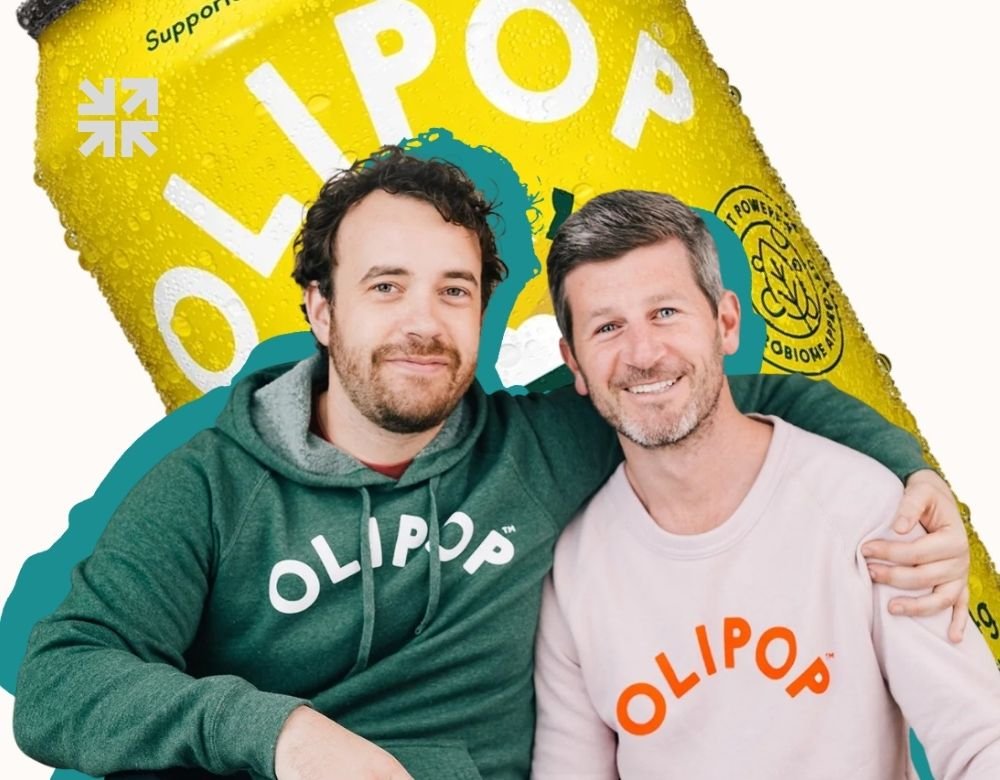
OLIPOP entered the U.S. beverage market in 2018 with a proposition that combined a familiar product format with a different nutritional profile. Founded by Ben Goodwin and David Lester, the company developed carbonated drinks containing prebiotic fiber and relatively low levels of sugar. Rather than creating an entirely new beverage occasion, OLIPOP positioned its products as an alternative within an existing category. That distinction became important as consumer interest in functional ingredients, digestive health and lower-sugar products increased.
The company has since moved well beyond the scale of an emerging beverage startup. OLIPOP was reported to have generated more than $400 million in annual sales and expanded its retail presence to nearly 50,000 stores. In February 2025, the company raised $50 million in Series C funding at a reported valuation of $1.85 billion. The numbers place OLIPOP among the more significant independent beverage companies in the U.S., but they also create a larger question around the business: how much further can the company grow from its current base?
A $1.85 Billion Valuation Against $400 Million+ Revenue
The $1.85 billion valuation represents more than the current size of OLIPOP’s business. Private-market valuations generally reflect expectations around future revenue, category expansion, profitability and market position. With reported annual sales above $400 million, the company had already established meaningful commercial scale when the latest funding round took place. The valuation therefore represents an expectation that the business can continue growing substantially rather than simply maintain its existing level of sales.
That creates a different challenge from the one OLIPOP faced in its earlier years. A young beverage company can grow rapidly by entering new stores, attracting its first customers and establishing awareness. At several hundred million dollars in annual revenue, the absolute amount of additional revenue required to maintain similar growth rates becomes much larger. Moving from $400 million to $800 million, for example, requires another $400 million in sales. That requires substantially more distribution, production capacity and recurring consumer demand.
The valuation therefore becomes a useful lens through which to examine the company’s next phase. The question is not whether OLIPOP has found consumers. The existing revenue indicates that it has. The question is whether the same proposition can continue generating strong growth at a much larger scale.
The Category Was Expanding With It
OLIPOP’s growth has taken place alongside a broader shift in the U.S. beverage market. Consumers have increasingly shown interest in products that combine familiar formats with functional ingredients or different nutritional profiles. Prebiotic beverages became one expression of that shift, creating space between traditional soft drinks and more specialized health-oriented products.
OLIPOP and Poppi became prominent independent brands within this segment. Their growth helped establish functional soda as a recognizable category rather than an isolated product concept. The category subsequently attracted larger beverage companies, bringing significantly greater distribution and marketing resources into the market.
This development is important for OLIPOP because category growth and competitive pressure are happening simultaneously. A larger category provides more potential consumers, but it also makes the market more attractive to companies with considerably greater resources.
The Product Is Familiar. The Competition Is Not.
One of OLIPOP’s commercial characteristics is the familiarity of its product format. The portfolio includes recognizable soda profiles such as cola, root beer and cream soda, while the formulation incorporates prebiotic fiber and lower sugar. Consumers therefore do not need to learn an entirely new way of consuming the product.
This familiarity can reduce the barrier to trial, but it also means that the concept can be replicated by competitors. Once consumers understand functional soda as a category, the decision becomes less about understanding the proposition and more about choosing between available brands.
That changes the competitive equation. Taste, price, availability, product formulation, brand recognition and consumer habits all begin to influence the purchase decision. The functional proposition can create differentiation, but it cannot by itself guarantee that consumers will repeatedly choose one brand over another.
Distribution Is Becoming More Important
OLIPOP’s expansion to nearly 50,000 stores represents a significant change from the company’s earlier stage. Beverage businesses depend heavily on physical availability because consumers typically purchase drinks through established retail channels rather than planning purchases far in advance.
However, increasing the number of stores does not automatically translate into proportional revenue growth. The more important metric is what happens within those stores. Product velocity, repeat purchasing, shelf placement, pricing and inventory levels determine how effectively distribution translates into sales.
This becomes particularly relevant as OLIPOP’s retail footprint grows. Maintaining strong sales across a larger network can require continued investment in marketing, retailer relationships and product availability. The company’s 2025 funding was intended in part to support product development, marketing and distribution, indicating that these areas remain central to its expansion strategy.
Coca-Cola and PepsiCo Changed the Competitive Landscape
The functional soda market became significantly more competitive in 2025 as major beverage companies moved into the category. Coca-Cola introduced Simply Pop, a prebiotic soda positioned around digestive health and lower sugar. The launch placed one of the world’s largest beverage companies directly into a space previously dominated by smaller emerging brands.
PepsiCo took a different approach by acquiring Poppi for approximately $1.95 billion. The transaction provided PepsiCo with an established brand in the same broader category in which OLIPOP operates.
These moves have two implications for OLIPOP. First, they indicate that large beverage companies see sufficient commercial potential in functional soda to justify significant investment. Second, they introduce competitors with established manufacturing, distribution and retail relationships.
For OLIPOP, category validation therefore comes with a cost. The company helped establish demand for the segment, but the segment is now attracting companies capable of competing at a much larger operational scale.
The Poppi Deal Provides a Useful Benchmark
The PepsiCo-Poppi transaction also gives investors and the broader market a reference point for how established beverage companies value brands in this category. The approximately $1.95 billion acquisition price is close to OLIPOP’s reported $1.85 billion private valuation, although the two numbers represent different types of transactions and should not be treated as directly equivalent.
Still, the comparison illustrates the strategic importance that functional soda had acquired by 2025. Two independent brands had reached valuations around the $2 billion level, while major beverage companies were simultaneously increasing their presence in the segment.
For OLIPOP, the comparison also raises questions about strategic independence, future capital requirements and the company’s ability to build sufficient scale without being absorbed by a larger beverage group. None of these outcomes is predetermined, but the category’s consolidation makes them relevant considerations.
The Next Stage Requires More Than Category Awareness
OLIPOP has already benefited from increasing awareness around functional beverages. The more difficult stage is converting that awareness into consistent, repeat consumption. A consumer trying one can creates a transaction, but regular purchasing creates a durable consumer business.
This becomes particularly important at OLIPOP’s current scale. The company needs to maintain demand across a large retail network while continuing to attract new households. At the same time, it has to manage pricing and product economics in a category where consumers now have more alternatives.
The company’s future growth will therefore depend on several factors working together. Distribution needs to expand without weakening retail economics. New products need to generate additional purchases rather than simply divide demand among existing products. Marketing needs to maintain awareness while acquisition costs remain manageable. Most importantly, consumers need to continue purchasing the product after the initial trial.
The $1.85 Billion Question
The most important number in OLIPOP’s current story may not be its valuation itself, but what that valuation implies about future performance. A $1.85 billion valuation attached to a business generating more than $400 million in annual sales suggests that investors see substantial room for further expansion.
That expectation will increasingly be tested against the realities of the beverage market. OLIPOP now has to operate at a larger scale, compete for retail space and respond to products backed by companies such as Coca-Cola and PepsiCo. The category itself is also likely to become less differentiated as more beverage companies introduce products with similar functional positioning.
The company’s next phase is therefore less about proving that functional soda can work and more about proving that OLIPOP can remain commercially relevant as the category matures.
Can the company turn a fast-growing beverage category into a durable, high-frequency consumer business?
That is the question behind the $1.85 billion valuation.