


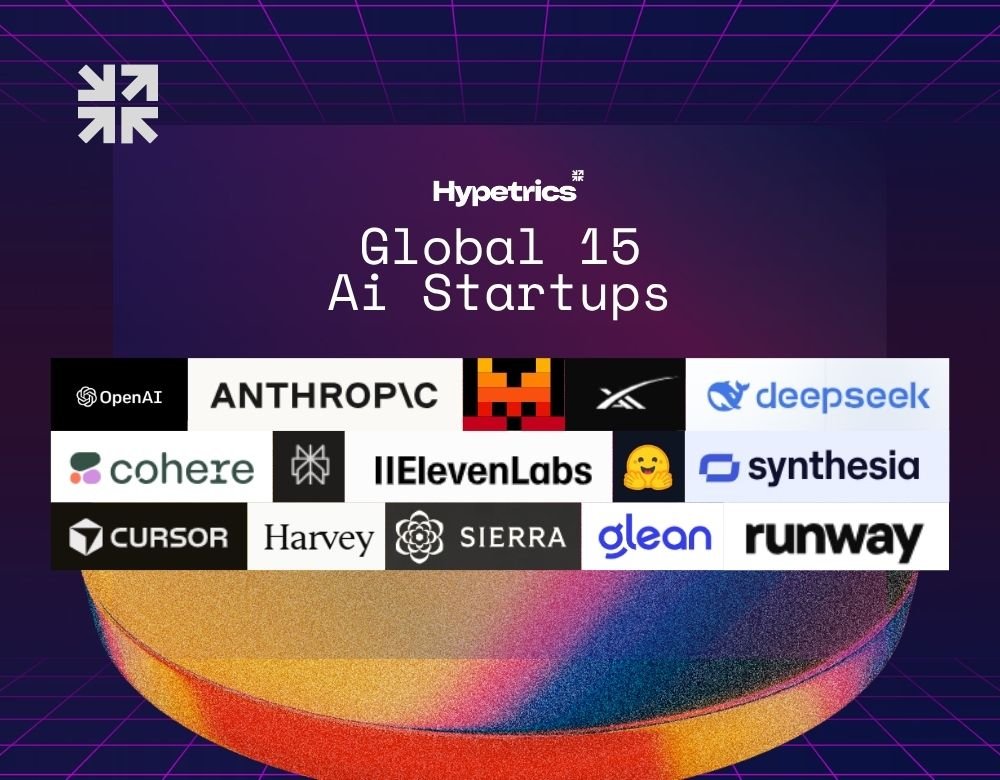
A Hypetrics Discovery Tracker of Companies Building Across the Next Generation of Artificial Intelligence
Artificial intelligence is no longer developing around one category. Foundation models are competing with specialised enterprise platforms, AI search, coding systems, creative tools, legal applications and increasingly autonomous agents.
Global 15 AI Startups brings together 15 companies operating across these different layers of the AI economy – from companies building core models to those turning AI into products for specific professional and creative workflows.
This is a Hypetrics discovery tracker, not a ranking. The companies are presented to map the breadth of the global AI startup ecosystem and the different problems entrepreneurs are attempting to solve.
| # | Company | Primary Market | Geography |
|---|---|---|---|
| 01 | OpenAI | Foundation AI | United States |
| 02 | Anthropic | Foundation AI | United States |
| 03 | Mistral AI | Foundation AI | France |
| 04 | xAI | Frontier AI | United States |
| 05 | DeepSeek | Foundation & Reasoning AI | China |
| 06 | Cohere | Enterprise AI | Canada |
| 07 | Perplexity | AI Search & Research | United States |
| 08 | ElevenLabs | AI Audio & Voice | UK / Poland |
| 09 | Synthesia | AI Video | United Kingdom |
| 10 | Hugging Face | Open AI Infrastructure | US / France |
| 11 | Cursor / Anysphere | AI Coding | United States |
| 12 | Harvey | Legal AI | United States |
| 13 | Sierra | Customer-Service AI | United States |
| 14 | Glean | Enterprise AI | United States |
| 15 | Runway | Generative Video & World Models | United States |
01. OpenAI
Founder Names: Sam Altman, Greg Brockman, Ilya Sutskever, John Schulman, Wojciech Zaremba and founding team
Market: Foundation AI, Generative AI, AI Agents
Website: OpenAI
OpenAI has become one of the central companies in the development and commercialisation of generative artificial intelligence. Founded as an AI research organisation, the company has expanded into a broad technology platform spanning foundation models, consumer applications, developer APIs and enterprise AI.
Its best-known product, ChatGPT, helped move generative AI from a specialist technology into a mainstream computing interface. The company has since expanded its model capabilities across reasoning, coding, image generation, voice and increasingly agentic tasks. OpenAI describes its broader objective around developing increasingly capable AI systems and deploying them in ways intended to be useful and beneficial.
OpenAI’s position is unusual because it operates simultaneously at several levels of the AI stack. Developers can build applications using its models, businesses can integrate AI into workflows, and consumers can interact directly with its products.
The company is also operating at an enormous infrastructure scale. In March 2026, OpenAI announced a $122 billion funding round at an $852 billion post-money valuation, illustrating the capital requirements associated with frontier AI development.
The market challenge for OpenAI is therefore no longer simply model capability. It is about converting increasingly powerful models into products, agents and infrastructure that can become embedded in how people work and use software.
OpenAI represents the foundation-model layer of the AI economy, but its next phase increasingly involves turning intelligence into an operating layer for digital work.
02. Anthropic
Founder Names: Dario Amodei, Daniela Amodei and founding research team
Market: Foundation AI, Enterprise AI, AI Safety
Website: Anthropic
Anthropic was founded around a research-led approach to building advanced AI systems with particular emphasis on reliability, interpretability and controllability. The company is led by co-founders Dario Amodei and Daniela Amodei and has developed Claude into one of the major general-purpose AI platforms.
Anthropic describes itself as an AI safety and research company working to build reliable, interpretable and steerable systems.
Claude has become the company’s primary interface with the market, but Anthropic’s broader proposition extends beyond an AI chatbot. Its models are used through APIs and enterprise deployments, placing the company in competition for the infrastructure layer behind business AI applications.
Enterprise adoption creates a different set of requirements from consumer AI. Companies need models that can work with proprietary information, integrate with existing software and operate within security and governance frameworks. Anthropic has increasingly positioned Claude around these requirements.
The company’s scale has also changed rapidly. In February 2026, Anthropic announced a $30 billion Series G round at a $380 billion post-money valuation.
Anthropic’s development reflects the increasing concentration of capital and research talent around frontier AI. The company is competing not just on benchmark performance, but on model reliability, enterprise adoption, developer distribution and the ability to build systems that can perform increasingly complex tasks.
Its central market question is how far a foundation-model company can move from being a model provider into becoming a long-term intelligence platform for organisations.
03. Mistral AI
Founder Names: Arthur Mensch, Guillaume Lample, Timothée Lacroix
Market: Foundation AI, Open Models, Enterprise AI
Website: Mistral AI
Mistral AI was founded in France in April 2023 by Arthur Mensch, Guillaume Lample and Timothée Lacroix. All three founders came from technical and research backgrounds, and the company entered a foundation-model market dominated largely by US technology companies.
Mistral’s proposition has centred on building advanced AI systems while maintaining an emphasis on model accessibility, deployment flexibility and enterprise control. Its portfolio has expanded from early language models into assistants, coding systems, multimodal models, OCR and agent infrastructure.
The company’s current enterprise proposition includes custom AI assistants, autonomous agents and multimodal AI, with deployment options spanning edge and cloud environments.
That makes Mistral relevant to a growing enterprise requirement: organisations do not necessarily want every AI workload to depend on a single closed model provider. They may require greater control over deployment, data, model selection and infrastructure.
Mistral has also developed a significant European identity. Its emergence gives France and Europe a prominent company operating in the foundation-model category at a time when governments and enterprises are increasingly discussing technological sovereignty.
The company is consequently competing on several dimensions at once — model performance, efficiency, openness, enterprise integration and geographic relevance.
Mistral’s trajectory illustrates how the global AI market is developing beyond a simple US-versus-China narrative. European companies are attempting to build their own model capabilities while creating commercial infrastructure around them.
The company’s next phase will depend on whether its combination of frontier research, enterprise deployment and model flexibility can translate into durable adoption in a market where model capabilities are advancing rapidly.
04. xAI
Founder: Elon Musk
Market: Frontier AI, Reasoning, Voice, Generative Media
Website: xAI / SpaceXAI
xAI was established with a focus on developing advanced AI systems and accelerating scientific discovery. Its best-known AI product is Grok, while the company’s technology stack increasingly spans reasoning, coding, voice, image and video generation.
The company has taken a highly infrastructure-intensive approach to frontier AI. Its website highlights Colossus, a large-scale computing system, alongside its frontier models and other AI products.
One of the more significant developments in xAI’s corporate trajectory came in February 2026, when SpaceX announced that it had acquired xAI. This changed the company’s position from an independent AI startup into part of a much broader technology and infrastructure ecosystem.
That combination is important because advanced AI increasingly depends on access to computing infrastructure, data, distribution and capital. xAI’s relationship with SpaceX potentially brings those components together in a single ecosystem.
The company had already demonstrated its ability to raise capital at substantial scale. In January 2026, xAI announced a $20 billion Series E funding round.
From a market perspective, xAI represents a different approach to building a frontier AI company: combine large-scale infrastructure with a broad model portfolio and access to an existing technology ecosystem.
Its trajectory also illustrates how quickly the structure of the AI market is changing. Companies that begin as standalone AI laboratories can become strategic assets within much larger technology platforms.
05. DeepSeek
Founder: Liang Wenfeng
Market: Foundation Models, Reasoning AI, Open Models
Website: DeepSeek
DeepSeek emerged from China as one of the most closely watched AI model companies outside the established US frontier-lab ecosystem. The company has focused heavily on model research, reasoning and computational efficiency.
Its public products include web and mobile AI experiences as well as an API platform for developers.
DeepSeek became particularly significant because its approach challenged assumptions about how much computing and capital are required to build competitive AI models. Its models drew attention for achieving strong performance while emphasising efficiency in model architecture and training.
The company’s development has also been closely associated with open model releases. In April 2026, DeepSeek released a preview of DeepSeek-V4, including a 1.6 trillion-parameter Pro version with 49 billion active parameters and a Flash version with 13 billion active parameters. The company positioned the release around a 1-million-token context window and cost-efficient inference.
This emphasis on efficiency is commercially important. As AI adoption grows, the economics of running models become increasingly important alongside raw intelligence. Lower inference costs can influence how widely developers and enterprises deploy AI.
DeepSeek therefore sits at an interesting intersection of research, open models and AI economics.
Its development has also become part of the broader global competition around AI capability, particularly as Chinese companies navigate restrictions on access to some advanced semiconductor technologies.
For the startup ecosystem, DeepSeek represents a model of competition based less on simply spending more and more on infrastructure and more on extracting greater performance from available computing resources.
06. Cohere
Founder Names: Aidan Gomez, Nick Frosst, Ivan Zhang
Market: Enterprise AI, Foundation Models, AI Agents
Website: Cohere
Cohere was founded by Aidan Gomez, Nick Frosst and Ivan Zhang and has developed a distinctly enterprise-focused position within the foundation-model market.
Rather than competing primarily for consumer attention, Cohere has focused on helping organisations deploy AI against proprietary data and business processes. Its platform combines generative models, enterprise search and AI agents.
The company’s current proposition is built around secure and customisable enterprise AI. Cohere describes its platform as enabling businesses to automate processes, empower employees and turn fragmented data into actionable information.
This focus reflects one of the central challenges in enterprise AI: businesses may have large amounts of internal information but lack systems capable of turning that information into usable intelligence without compromising security or governance.
Cohere’s North platform addresses this through enterprise AI capabilities, including intelligent search and agents for routine tasks and more complex workflows.
The company’s business has also expanded geographically. In 2025, Cohere announced partnerships with the Canadian and UK governments around secure AI and sovereign technology capabilities. In 2026, it also announced a partnership with Aston Martin’s Formula One team around secure enterprise AI.
In August 2025, Cohere raised $500 million at a $6.8 billion valuation to accelerate enterprise and sovereign AI development.
Cohere’s position is therefore less about becoming a consumer AI destination and more about becoming part of the infrastructure through which enterprises operationalise AI.
07. Perplexity
Founder Names: Aravind Srinivas, Denis Yarats, Johnny Ho, Andy Konwinski
Market: AI Search, Research, AI Assistants
Website: Perplexity
Perplexity entered the AI market through search rather than by trying to become another standalone foundation-model laboratory. Its product combines conversational interaction with web retrieval, allowing users to ask questions and receive synthesised answers with supporting sources.
The approach addresses a familiar problem: traditional search can require users to open multiple pages, compare information and construct an answer themselves. Perplexity attempts to compress that process into an AI-assisted research workflow.
The company has increasingly expanded beyond search toward assistants and task-oriented AI. Its distribution has also broadened significantly. In February 2026, Perplexity announced a deep integration with Samsung Galaxy S26 devices, where it powers search and reasoning capabilities alongside Samsung’s Bixby.
That kind of integration matters because AI search is fundamentally a distribution business. The technology has to become part of users’ everyday information habits rather than remain a destination people occasionally visit.
Perplexity’s model also highlights the importance of the application layer. It does not necessarily need to own every model that powers its system. Its value can come from combining retrieval, model selection, citations, browsing and interface design into a coherent research experience.
The competitive environment is consequently broad. Perplexity competes with traditional search engines, general-purpose AI assistants and emerging AI agents.
Its longer-term proposition is increasingly about becoming an AI interface for finding and acting on information.
The company’s trajectory will depend on whether users continue to shift information-seeking behaviour toward conversational research and whether Perplexity can turn that behaviour into a durable business model.
08. ElevenLabs
Founder Names: Mati Staniszewski, Piotr Dąbkowski
Market: AI Audio, Voice AI, Dubbing
Website: ElevenLabs
ElevenLabs was founded in 2022 by Mati Staniszewski and Piotr Dąbkowski with an initial focus on improving the quality of AI-generated voice and dubbing. Dąbkowski previously worked as a machine-learning engineer at Google, while Staniszewski worked at Palantir.
The company began with text-to-speech technology capable of producing increasingly natural-sounding synthetic voices. It has since expanded well beyond that initial category.
ElevenLabs now describes itself as an AI research and product company working across multiple platforms. Its broader proposition covers voice, audio, conversational interfaces and other forms of AI-generated communication.
That expansion creates several potential markets. Media companies can use AI for dubbing and localisation. Developers can build voice interfaces. Businesses can use synthetic speech for customer interactions, while creators can generate audio without traditional recording workflows.
Voice is also becoming increasingly relevant to AI agents. If AI systems are expected to interact with people rather than simply generate text, natural speech becomes part of the interface layer.
The category comes with its own complications. Voice cloning raises questions around consent, identity, copyright and misuse. As the technology becomes more realistic, the ability to establish provenance and permission becomes increasingly important.
ElevenLabs therefore operates in a market where technical quality and trust have to develop together.
Its evolution from a specialised text-to-speech startup into a broader AI audio platform illustrates how a single generative modality can become an infrastructure layer for multiple industries.
09. Synthesia
Founder Names: Victor Riparbelli, Steffen Tjerrild, Prof. Matt Niessner, Prof. Lourdes Agapito
Market: AI Video, Enterprise Communications, Learning & Development
Website: Synthesia
Synthesia was founded in 2017 by Victor Riparbelli, Steffen Tjerrild, Prof. Matt Niessner and Prof. Lourdes Agapito, bringing together researchers and entrepreneurs connected with Stanford, Cambridge, UCL and TUM.
The company’s core proposition is to make professional video production possible without traditional requirements such as cameras, actors and studios. Its primary market is business rather than consumer entertainment.
That distinction shapes the product. Synthesia has focused heavily on use cases such as employee training, onboarding, internal communications and knowledge sharing — areas where companies frequently need to produce and update large volumes of video content.
Its platform has expanded around AI avatars, multilingual video creation, video agents and related enterprise capabilities. Synthesia says its platform is designed to transform how organisations train, onboard and upskill employees.
The company has also made AI safety and ethics a visible part of its operating model, stating that 10% of its team will remain dedicated to AI safety and ethics.
Its commercial scale has expanded alongside the product. In 2023, Synthesia said more than 50,000 businesses, including a third of the Fortune 100, were using its platform. More recent company material says more than 65,000 businesses use its technology.
The bigger market question is whether AI video becomes simply a cheaper production method or evolves into a new enterprise communication format.
Synthesia is positioned around the latter — making video production repeatable, localisable and integrated into everyday business workflows.
10. Hugging Face
Founder Names: Clément Delangue, Julien Chaumond, Thomas Wolf
Market: Open AI Infrastructure, Models, Datasets, Developer Tools
Website: Hugging Face
Hugging Face occupies a different position from most companies on this list. Instead of competing primarily by building a single frontier model, it has built infrastructure and a community around the development, sharing and deployment of AI models and datasets.
The company was founded in 2016 by Clément Delangue, Julien Chaumond and Thomas Wolf. It originally started as a chatbot aimed at teenagers before pivoting toward machine-learning infrastructure and open-source AI.
That pivot became central to the company’s identity. Hugging Face developed the Transformers library and created a platform where developers and researchers could share models, datasets and applications.
Its importance lies in the ecosystem around AI rather than a single model. Developers can discover models, experiment with them, collaborate on projects and deploy AI systems through the platform.
The open-source approach has made Hugging Face a central meeting point between research communities, independent developers and companies.
The company has also become strategically important enough to attract major technology investors. In 2023, Salesforce Ventures described it as a central hub connecting AI developers, researchers and enthusiasts.
More recently, Hugging Face has attracted reported acquisition interest from Nvidia at a potential valuation above $13 billion, although no transaction had been finalised at the time of reporting.
That development highlights the strategic importance of AI infrastructure beyond foundation models.
Hugging Face’s market proposition is ultimately about making AI development more accessible, collaborative and distributed — a role that becomes increasingly important as the number of models and AI applications continues to expand.
11. Cursor / Anysphere
Founder Names: Michael Truell, Sualeh Asif, Aman Sanger, Arvid Lunnemark
Market: AI Coding, Developer Tools, Coding Agents
Website: Cursor
Cursor is the AI-native coding environment developed by Anysphere, founded by Michael Truell, Sualeh Asif, Aman Sanger and Arvid Lunnemark. The four founders met while at MIT and initially set out to build an integrated development environment that could improve common software-engineering tasks.
The distinction between Cursor and traditional coding assistants is important. Rather than treating AI as an autocomplete feature, Cursor integrates AI more deeply into the development environment, allowing developers to work with codebases, ask questions, generate and modify code and address bugs.
The company’s early product strategy was explicitly focused on what came after autocomplete. That means understanding codebases, debugging and helping developers navigate larger software projects.
The category has since moved toward agentic software development. AI systems are increasingly being asked to take instructions, make changes across files, run tasks and complete larger pieces of engineering work.
Cursor’s growth reflects the commercial potential of this shift. Developers represent a particularly attractive AI user group because their work is already structured around digital tools, and productivity gains can be measured against software output.
The competitive landscape includes GitHub Copilot, model providers and a growing group of AI-native coding companies.
Anysphere’s trajectory also illustrates how rapidly AI application companies can scale when the product is embedded directly inside a high-frequency professional workflow.
The bigger question for the category is not whether AI will assist programmers. That transition is already underway. The more significant question is how much software engineering can eventually be delegated to AI systems.
Cursor is positioned directly at that transition from AI-assisted coding to AI-directed software development.
12. Harvey
Founder Names: Gabriel “Gabe” Pereyra, Winston Weinberg
Market: Legal AI, Professional Services, AI Agents
Website: Harvey
Harvey was founded by Gabriel Pereyra and Winston Weinberg, combining technical AI expertise with legal-sector experience. Pereyra previously worked as a DeepMind researcher, while Weinberg worked as a securities and antitrust litigator. The founders began experimenting with generative AI and identified opportunities to apply it to legal work.
Harvey’s approach is an example of vertical AI: instead of building a general-purpose assistant and asking users to adapt it to their profession, the company builds around the workflows, terminology and requirements of a specific industry.
Legal work provides a particularly large application area because lawyers spend substantial amounts of time working with documents, conducting research, drafting material and analysing complex information.
Harvey has moved increasingly toward AI agents capable of executing longer legal workflows. In March 2026, the company announced a $200 million funding round at an $11 billion valuation and said its focus was expanding the agents customers run on its platform and the legal-engineering teams supporting those deployments.
The company had already reported more than 500 customers across 54 countries and more than $100 million in annual recurring revenue in 2025.
Those numbers indicate how quickly specialised AI applications can move from experimentation into enterprise infrastructure.
The challenge is equally significant. Legal AI must deal with accuracy, confidentiality, jurisdictional differences and professional accountability.
Harvey’s market therefore extends beyond automating individual legal tasks. Its larger proposition is to become an AI infrastructure layer through which law firms and corporate legal teams execute increasingly complex workflows.
The company is one example of where the AI market may be heading next: from generic intelligence toward domain-specific execution.
13. Sierra
Founder Names: Bret Taylor, Clay Bavor
Market: AI Customer-Service Agents, Enterprise AI
Website: Sierra
Sierra was co-founded by Bret Taylor and Clay Bavor, two executives with extensive experience building large technology products. Taylor previously served as co-CEO of Salesforce, CTO of Facebook and founder of Quip, while Bavor spent 18 years at Google and led Google Labs, Google Lens and Google’s AR/VR work.
Sierra’s proposition is centred on AI agents that handle customer interactions and execute tasks rather than simply responding to frequently asked questions.
This distinction changes the economics of customer service. Traditional support software organises the work of human agents. AI agents can potentially perform parts of that work directly — including understanding customer intent, retrieving information, interacting with business systems and completing transactions.
Sierra has focused on enterprise customers, including companies across financial services, healthcare, telecommunications, retail and consumer services.
The company reported reaching $100 million in annual recurring revenue seven quarters after launching in February 2024.
It also raised $350 million in September 2025 at a $10 billion valuation.
The market is now moving toward more sophisticated agent behaviour. Sierra’s recent product direction includes longer-horizon interactions, where agents can coordinate customer relationships over days or weeks rather than handling one conversation at a time.
The underlying challenge is reliability. Customer-service agents operate directly in customer relationships, meaning errors can have financial and reputational consequences.
Sierra’s position is therefore less about replacing a chatbot and more about creating an AI execution layer for customer operations.
That makes it one of the companies worth watching as enterprise AI moves from answering questions to actually completing work.
14. Glean
Founder: Arvind Jain
Market: Enterprise AI, Workplace Search, AI Agents
Website: Glean
Glean began in 2019 as an enterprise search company built around a simple workplace problem: employees struggle to find information spread across multiple software systems.
Founder Arvind Jain had previously co-founded Rubrik and spent more than a decade at Google working across Search, Maps and YouTube.
The arrival of generative AI changed the size of the opportunity. Instead of simply helping employees locate documents, Glean could use company information as context for AI-generated answers and workflows.
The company has consequently evolved from enterprise search into what it describes as a Work AI platform. Its technology combines search, retrieval-augmented generation, enterprise knowledge and AI agents.
One of the key issues Glean addresses is context. General-purpose AI models may know a great deal about the world, but they do not automatically know an individual company’s policies, documents, customers, projects and internal processes.
Glean attempts to create that enterprise context while maintaining permissions and governance. The company describes its system as grounded in trusted company information and designed to preserve source permissions.
Its commercial trajectory has also accelerated. Glean reported crossing $100 million ARR earlier in its growth and announced in May 2026 that it had surpassed $300 million ARR.
The company is now moving deeper into agent infrastructure, helping enterprises build, govern and measure AI agents.
Glean’s significance is therefore not just enterprise search. It represents the broader movement toward company-specific AI, where models become useful because they understand the organisation around them.
15. Runway
Founder Names: Cristóbal Valenzuela, Anastasis Germanidis, Alejandro Matamala-Ortiz
Market: Generative Video, Multimodal AI, World Models
Website: Runway
Runway was founded by Cristóbal Valenzuela, Anastasis Germanidis and Alejandro Matamala-Ortiz and initially became known for bringing generative AI into professional creative workflows.
Its technology has since moved beyond the narrow definition of AI video generation. Runway now describes its broader research direction around world models — AI systems designed to simulate aspects of the world rather than simply generate isolated pieces of content.
The distinction is significant.
Generative video can create visual sequences from instructions. A world model aims at something broader: understanding environments, objects, actions and how they change over time. Runway argues that this type of simulation could have applications beyond entertainment, including robotics and scientific discovery.
The company continues to operate a substantial creative product ecosystem, with tools spanning creative production, development, research and enterprise applications. Its current platform includes creative tools, developer products and research into general-purpose multimodal simulation.
Runway’s leadership structure has also evolved. In February 2026, co-founder Anastasis Germanidis became co-CEO alongside Cristóbal Valenzuela, formalising a leadership structure that the company said reflected an existing division of responsibilities.
The company’s trajectory demonstrates how quickly generative AI categories can expand. A startup that initially gained attention for AI-generated video is now positioning its technology around a much larger question: whether AI can learn representations of the physical world through simulation.
For the creative industry, Runway remains an important generative-AI platform. For the wider AI market, its world-model research places the company closer to the emerging intersection of multimodal intelligence, simulation and embodied AI.
What this tracker shows
The 15 companies point to a market that is becoming less about one AI product and more about where intelligence gets embedded.
Foundation-model companies are building the underlying intelligence layer. Companies such as Perplexity are changing how people access information. Cursor is pushing AI deeper into software development. Harvey is applying it to professional services, while Sierra and Glean are connecting AI with enterprise workflows. ElevenLabs and Synthesia are taking generative AI into audio and video, while Runway is moving toward world simulation.
The common thread is not a particular model architecture or product category.
It is the transition from AI that generates responses to AI that understands context, operates inside workflows and increasingly performs tasks.
Hypetrics Global 15 AI Startups is a discovery tracker - not a ranking, designed to map transition across companies, categories and markets.