


From a ₹44,048 crore protein-based product market to growing demand for supplements, whey, bars and everyday high-protein foods, the data shows how India’s protein consumption is changing.
India’s protein market is no longer limited to gyms and bodybuilding.
Protein powders, whey, bars, beverages, dairy products and protein-enriched foods are becoming part of a broader consumer category. At the same time, India’s protein intake continues to come largely from conventional foods.
The latest market estimates, government data and 2026 consumer research point to a category developing across both dimensions: more products are being built around protein, while consumers are becoming more conscious of protein in their diets.
India’s Protein-Based Product Market Has Reached ₹44,048 Crore
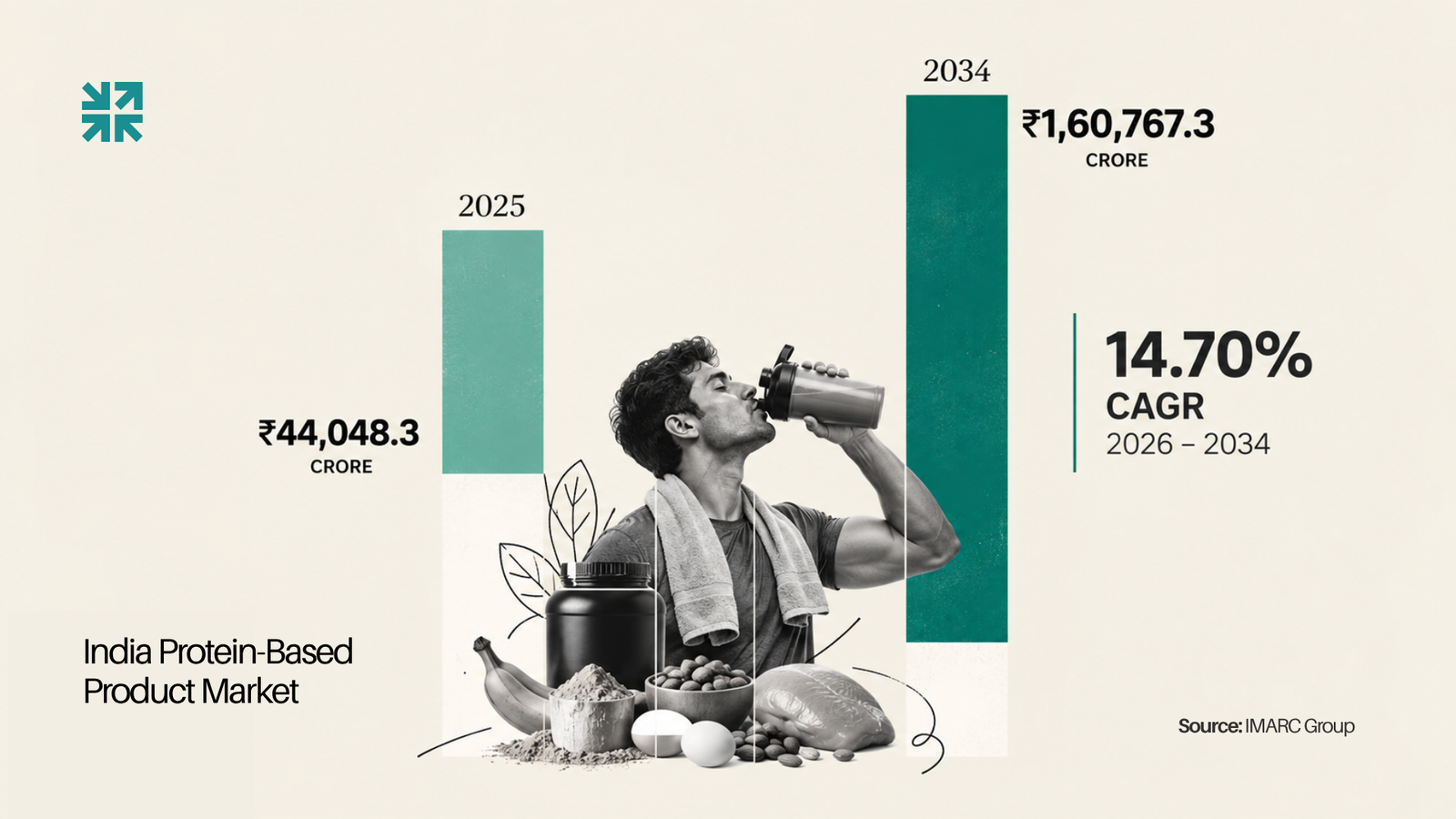
India’s protein-based product market was valued at ₹44,048.3 crore in 2025, according to IMARC Group. The market is projected to reach ₹1,60,767.3 crore by 2034, representing a 14.70% CAGR between 2026 and 2034.
The broader market includes protein powders, bars, supplements, drinks, cereals, protein-rich snacks and other protein-based food and beverage products. Animal and dairy protein represented the largest source segment in 2025, while South India was the largest regional market.
The Protein Supplement Market Is a Smaller Segment
The dedicated protein supplement market provides a narrower view of India’s commercial protein consumption.
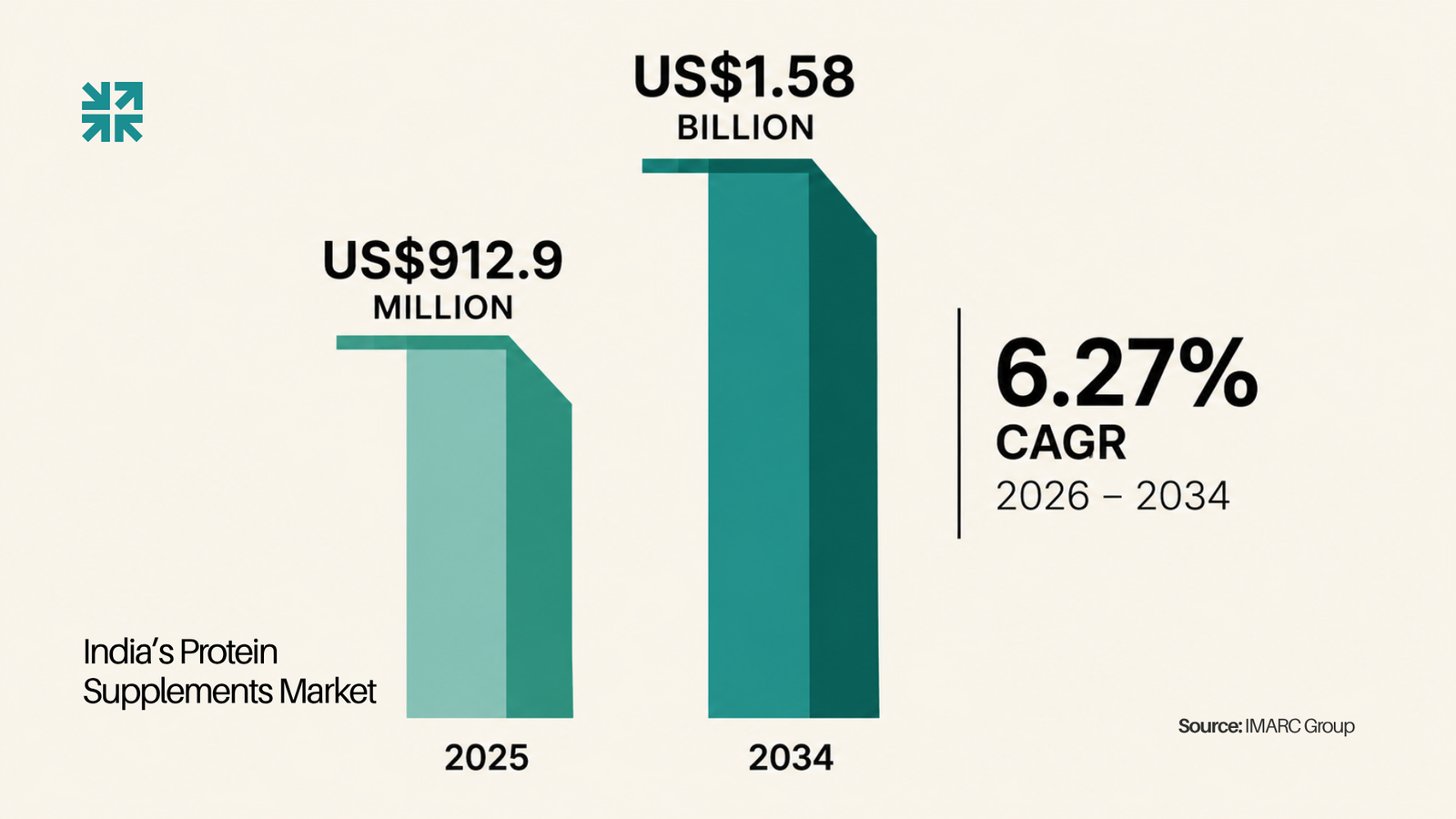
IMARC estimates India’s protein supplements market at US$912.9 million in 2025. The market is projected to reach US$1.58 billion by 2034, growing at a 6.27% CAGR between 2026 and 2034.
The category includes products such as protein powders and other nutritional supplements.
This distinction matters because India’s protein opportunity is considerably larger than the traditional protein-supplement category.
Whey Protein Remains a Distinct Market
Whey continues to be one of the most established protein formats in India.
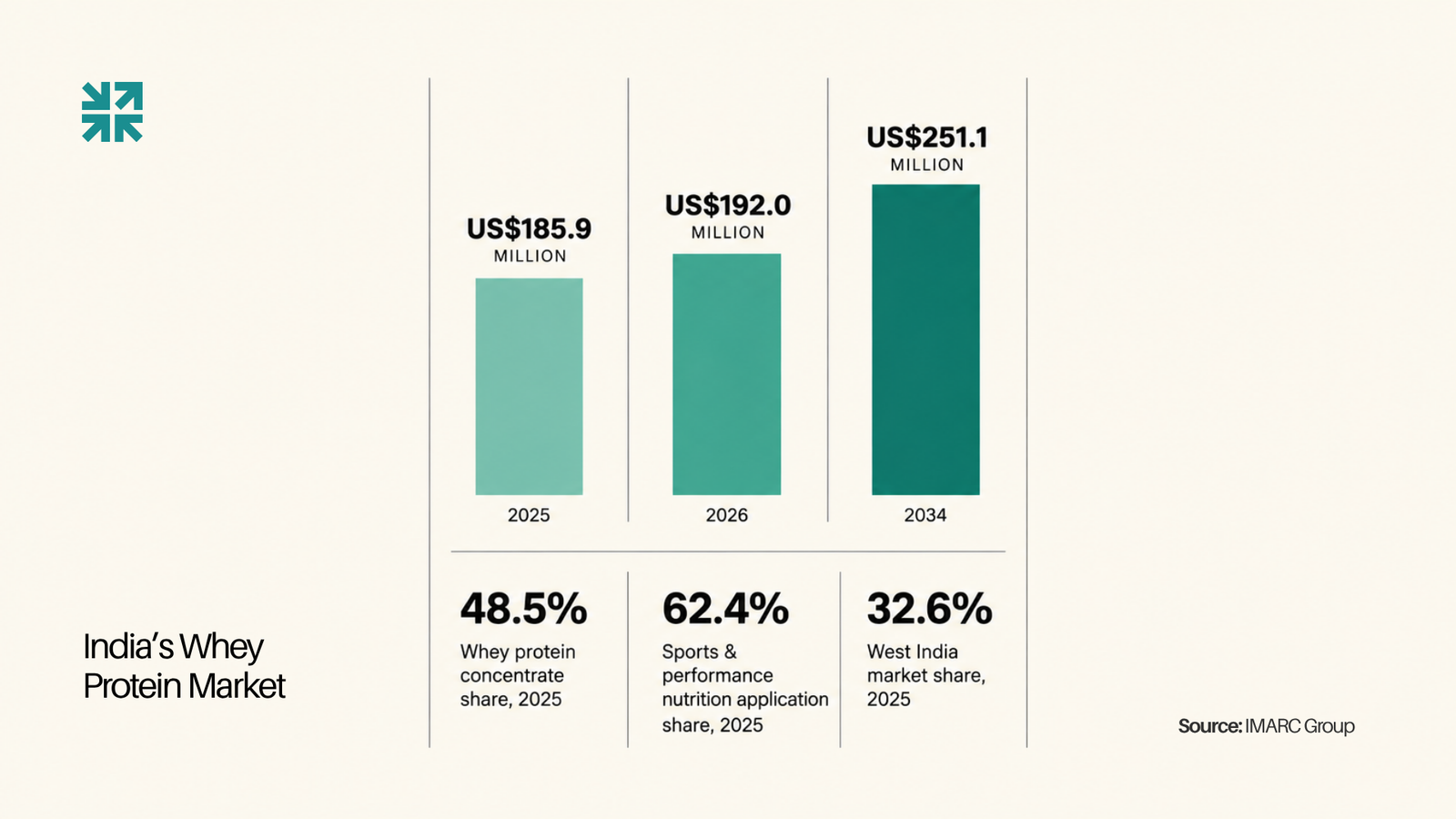
The India whey protein market increased from US$185.9 million in 2025 to an estimated US$192 million in 2026, according to IMARC. It is projected to reach US$251.1 million by 2034, representing a 3.27% CAGR between 2026 and 2034.
Whey protein concentrate accounted for 48.5% of the market in 2025, while sports and performance nutrition represented 62.4% of applications. West India accounted for 32.6% of the market in 2025.
The data indicates that whey remains closely connected to India’s fitness and sports-nutrition consumer base, even as protein itself expands into broader food categories.
Protein Bars Are Creating Another Consumption Occasion
Protein is also moving into the snacking category.
India’s protein bar market reached an estimated US$130.2 million in 2025. IMARC projects the category to reach US$200.7 million by 2034, representing a 4.68% CAGR between 2026 and 2034.
Unlike protein powders, bars can fit into multiple consumption occasions. They can be consumed between meals, during travel, at work or after exercise.
This gives the category relevance beyond consumers who actively identify with fitness or bodybuilding.
India’s Protein Intake Still Comes Mainly From Conventional Food
The commercial market tells only part of India’s protein story.
The latest nationally representative official data comes from the Household Consumption Expenditure Survey 2023-24, published by India’s Ministry of Statistics and Programme Implementation.
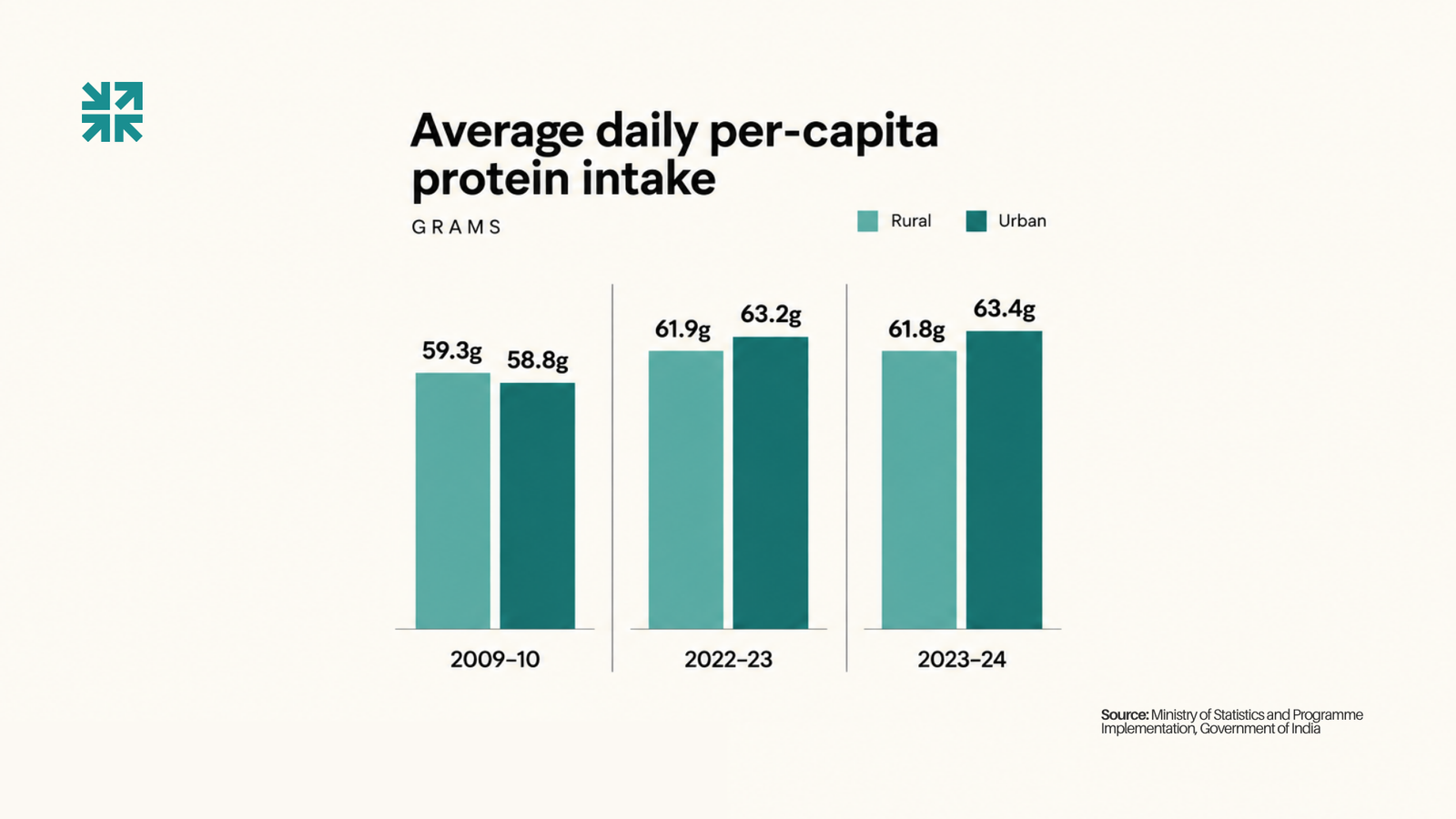
Average daily per-capita protein intake in 2023-24 was 61.8 grams in rural India and 63.4 grams in urban India. The corresponding figures in 2022-23 were 61.9 grams and 63.2 grams respectively.
This means urban per-capita protein intake increased slightly between 2022-23 and 2023-24, while rural intake remained broadly stable.
The same dataset shows a longer-term increase. Rural protein intake rose from 59.3 grams in 2009-10 to 61.8 grams in 2023-24. Urban intake increased from 58.8 grams to 63.4 grams over the same period.
Cereals Still Supply a Large Share of India’s Protein
India’s growing packaged protein market has not replaced conventional sources.
Cereals remain the largest contributor to protein intake among the five broad food groups tracked in the government’s nutritional-intake analysis.
In 2023-24, cereals accounted for 45.9% of protein intake in rural India and 38.7% in urban India. Pulses contributed 8.7% in rural India and 9.1% in urban India, while milk and milk products contributed 11.0% and 12.9% respectively.
Egg, fish and meat contributed 12.4% of rural protein intake and 14.1% of urban protein intake in 2023-24.
Consumer Awareness Is Growing, But Confusion Remains
The commercial opportunity is also being shaped by consumer awareness.
A PulseAI Research study published in 2026 surveyed 2,000 Indian consumers, ranging from fitness enthusiasts to casual eaters, to understand how Indians consume and evaluate protein.
The research found a gap between consumer awareness and actual clarity around protein.
PulseAI reported that 41% of respondents actively track or estimate their protein intake. The research also found that 93% of consumers who regularly track their protein intake reported confusion around protein-related information.
Affordability Remains a Consumer Consideration
A separate 2026 survey commissioned by Country Delight and conducted with LocalCircles collected more than 207,000 responses across India’s top 25 metro and urban districts.
The survey found that 74% of respondents did not know the recommended daily protein requirement for an average adult, while 85% did not track their daily protein intake.
The study also reported that 71% of respondents were willing to switch to more affordable protein alternatives.
Protein Is Becoming a Product Attribute
The first major wave of India’s packaged protein market was closely associated with:
Whey → Gym → Muscle → Performance
The broader category now looks different.
Protein is appearing across dairy, snacks, beverages, breakfast products, functional foods and supplements.
This expands the potential consumer base.
A consumer does not necessarily need to identify as a fitness enthusiast to purchase a product positioned around protein.
Protein can increasingly function as a product attribute, rather than being the entire reason for purchase.
Plant Protein Adds Another Layer
Plant-based protein is also becoming a distinct part of India’s protein market.
IMARC estimates India’s plant-based protein market at US$634.3 million in 2025.
The market is projected to reach US$2.25 billion by 2034, representing a 14.36% CAGR between 2026 and 2034.
Soy protein represented 38.4% of the market in 2025, while pea protein was identified as the fastest-growing source segment.
What the Data Shows
India’s protein market is developing across several distinct layers.
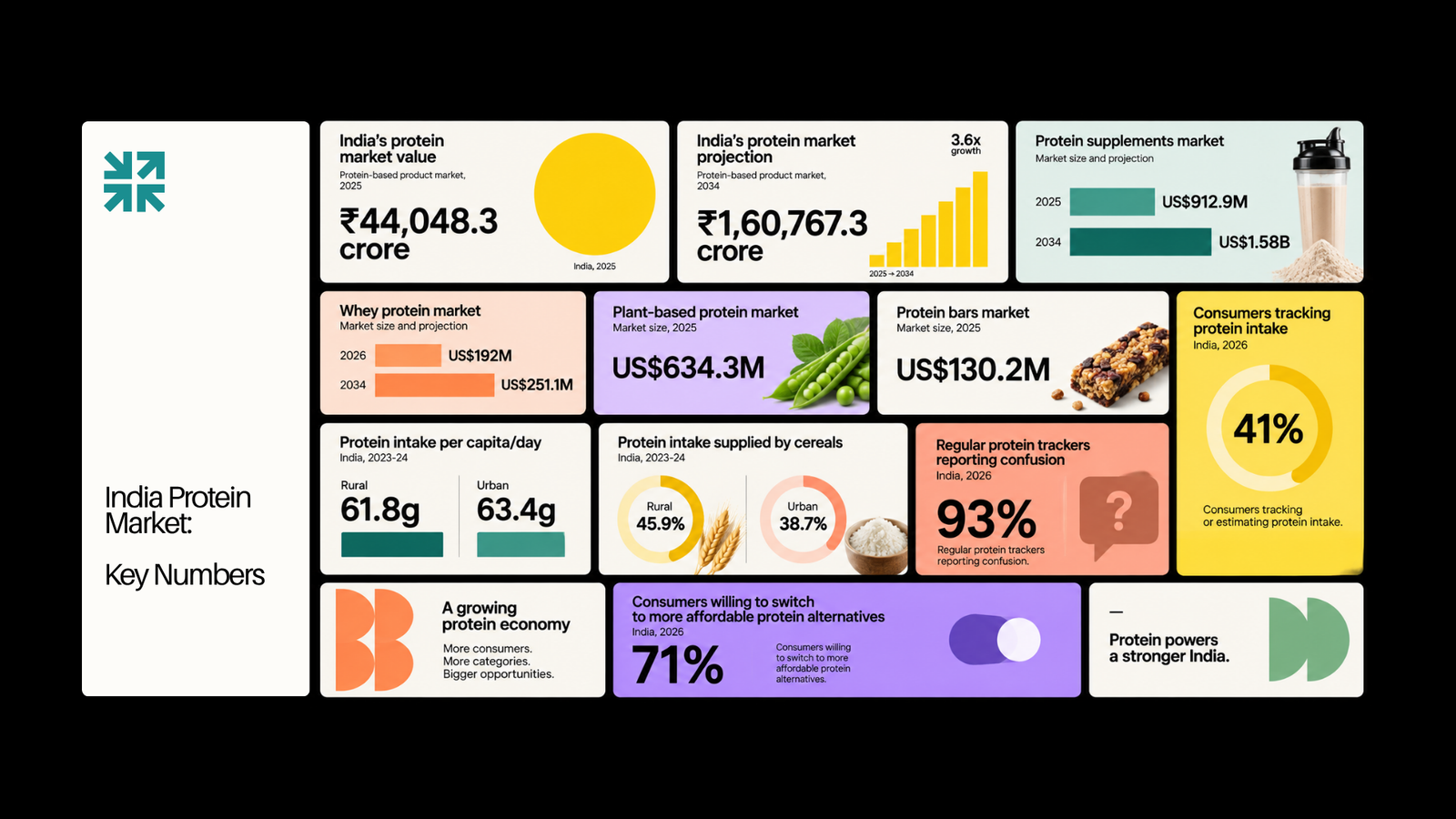
The broader protein-based product market reached ₹44,048.3 crore in 2025, while the dedicated protein supplements market was estimated at US$912.9 million. Whey represented an estimated US$192 million market in 2026, while protein bars represented a US$130.2 million market in 2025 under IMARC’s respective definitions.
At the same time, India’s protein consumption remains rooted in conventional food. Rural Indians consumed an average of 61.8 grams of protein per day per capita in 2023-24, compared with 63.4 grams in urban India. Cereals supplied 45.9% of rural protein intake and 38.7% of urban intake.
The market is therefore not simply moving from traditional food to supplements.
It is becoming more fragmented.
Consumers can now obtain protein through traditional meals, dairy, eggs, meat, protein-rich snacks, bars, beverages, plant-based products and supplements.
Hypetrics Intelligence
India’s protein opportunity is becoming less about a single product category and more about a broader consumption behaviour.
The ₹44,048.3 crore protein-based product market captures the scale of the opportunity beyond supplements. The supplement market provides a more focused view of consumers purchasing specialised protein products. Meanwhile, official nutritional data shows that conventional food remains the foundation of protein consumption in India.
The important shift is therefore not simply that Indians are buying more protein powder.
It is that protein is becoming a mainstream product attribute.
A protein claim can now sit on a milk product, snack, beverage, breakfast food or bar without requiring the consumer to enter the traditional sports-nutrition category.
For brands, this creates a wider competitive field.
For consumers, it creates more choice, but also more information to evaluate.
The next phase of India’s protein market will depend on how effectively brands combine nutrition, affordability, convenience and consumer understanding.
This report has been prepared by the Hypetrics Research Desk using published market estimates, government statistics and consumer research available at the time of publication.

Market estimates are sourced primarily from IMARC Group. Nutritional-intake figures are based on the Government of India's Household Consumption Expenditure Survey 2023-24: Nutritional Intake in India. Consumer behaviour insights are based on 2026 research from PulseAI Research and LocalCircles/Country Delight.

Market estimates from different research providers use different methodologies and category definitions. They should not be added together.

The term “Hypetrics Market Intelligence” refers to Hypetrics' research compilation, data structuring and analysis of the cited datasets. It does not imply that Hypetrics independently collected the underlying market or survey data.