


The packaged food industry has traditionally sold products through taste, convenience and aspiration. The Whole Truth took a different route. It made the ingredient list part of the product itself. Instead of hiding behind broad claims such as “healthy” or “natural”, the brand built its proposition around telling consumers exactly what goes into its food.
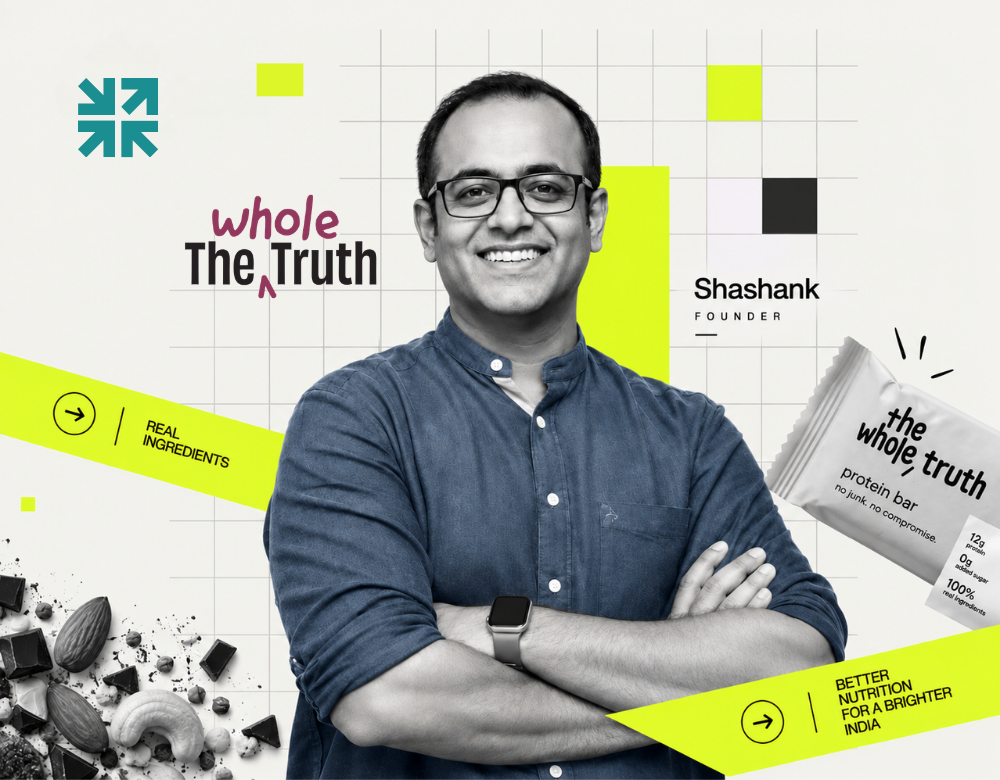
Founded in 2019 by Shashank Mehta, The Whole Truth started with a simple observation about the gap between what packaged food communicates and what it actually contains. The opportunity was not simply to create another healthy food brand. It was to change the way consumers evaluate packaged food by making ingredients visible, understandable and central to the buying decision.
That approach became the foundation of the company’s identity. The brand positioned itself around real food and full ingredient transparency, with the promise of declaring every ingredient upfront. Packaging therefore became more than a surface for branding. It became a communication channel between the company and the consumer.
Over time, that original idea expanded beyond a narrow clean-label proposition. The Whole Truth built a portfolio across protein powders, protein bars, energy bars, muesli, nut spreads and dark cocoa products. Its protein portfolio now spans different formats and nutritional requirements, including products positioned around higher protein intake and plant-based nutrition.
The expansion reflects a broader shift in the way Indian consumers approach packaged food. Protein has moved from being a niche requirement associated with athletes and fitness enthusiasts into a much wider consumer conversation. Convenience has also become important. Consumers increasingly want products that fit into everyday routines without requiring extensive preparation.
The Whole Truth has built its product portfolio around these changing consumption occasions. Protein powders address a more structured nutrition requirement, while bars and smaller formats fit into on-the-go consumption. Muesli and nut spreads extend the brand into breakfast and everyday eating. This creates a wider relationship with the consumer than a single-category food product would allow.
The company’s growth is visible in its financial performance. The Whole Truth reported revenue from operations of ₹216 crore in FY2025, compared with ₹65 crore in FY2024. That represents a 232% increase in revenue over the period. The scale of this increase indicates how quickly protein and clean-label packaged food have expanded as commercial categories in India.
However, the revenue trajectory also needs to be viewed alongside the economics of building a consumer food business. The company reported a net loss of around ₹28 crore in FY2025. The numbers point to a business that was scaling rapidly while continuing to invest in products, distribution, manufacturing capabilities and brand building.
This distinction is important. Revenue growth alone does not explain the evolution of a packaged food company. The larger question is whether a brand can turn increasing distribution and consumer awareness into repeat purchases and sustainable economics. As The Whole Truth expands, these factors become increasingly important to its next stage of growth.
The company has also treated education as part of its brand-building approach. Its content initiative, Truth Be Told, extends the conversation beyond individual products into food, nutrition and consumer understanding. This is consistent with the company’s original proposition. If transparency is the central promise, consumers need more than an ingredient declaration. They also need a better understanding of what those ingredients mean.
This approach becomes particularly relevant as the brand moves into new consumer segments. The Whole Truth has expanded into children’s nutrition through its Next Gen range, which includes products for different age groups as well as snack formats. The category introduces a different set of considerations because parents are not simply evaluating taste and convenience. They are also assessing ingredients, nutritional value and the messages attached to children’s food.
The move into children’s nutrition therefore takes the original clean-label proposition into a more sensitive consumption environment. The company has positioned the range around reducing fear and guilt in children’s food marketing while focusing on clearer information about what children consume.
The broader portfolio also changes the competitive landscape for the company. The Whole Truth is no longer operating only within the protein bar or clean-label niche. It is increasingly participating across multiple segments of the packaged nutrition market. That brings a larger addressable market, but it also creates a more complex operating environment.
Different categories require different consumption occasions, pricing structures, distribution strategies and repeat-purchase behaviour. A consumer buying a protein powder may have a very different purchase cycle from someone buying a snack bar or breakfast product. Building a common brand proposition across these categories becomes an important strategic challenge.
Distribution is another part of this transition. The growth of quick-commerce and digital marketplaces has changed how consumers discover and purchase packaged food. Products can now reach consumers through a combination of direct channels, marketplaces and rapid-delivery platforms. For brands operating in food and nutrition, this creates more opportunities to increase availability while also increasing competition for visibility.
The Whole Truth’s proposition gives it a distinctive communication framework within this environment. Its central idea is relatively simple: tell consumers what is actually in the food. The challenge is maintaining that clarity as the number of products, categories and consumer segments increases.
The company’s evolution also reflects a larger change in India’s food market. Consumers are becoming more attentive to protein intake, ingredient quality and nutritional information. At the same time, they continue to demand convenience and accessible formats. This creates space for brands that can combine nutritional positioning with products that fit everyday consumption.
For The Whole Truth, the next phase is therefore not only about adding more products. It is about extending the original idea across a much larger food business without diluting what made the proposition relevant in the first place.
The company now has to operate across product development, manufacturing, distribution, consumer education and brand building at a significantly larger scale than when it started. Its FY2025 revenue of ₹216 crore provides a clear indication of how far that journey has progressed from its early clean-label positioning.
The bigger question for the business is what happens after that initial scale-up. Can ingredient transparency remain a meaningful differentiator when the brand operates across multiple categories? Can the company build strong repeat consumption rather than relying primarily on customer acquisition? And can its growing portfolio eventually translate rapid revenue expansion into stronger business economics?
The Whole Truth began by challenging how packaged food communicates with consumers. Its growth has now turned that proposition into a much broader business spanning protein, snacks, nutrition and children’s food. The company’s story is increasingly about whether a single principle, transparency, can support a large consumer food platform.