


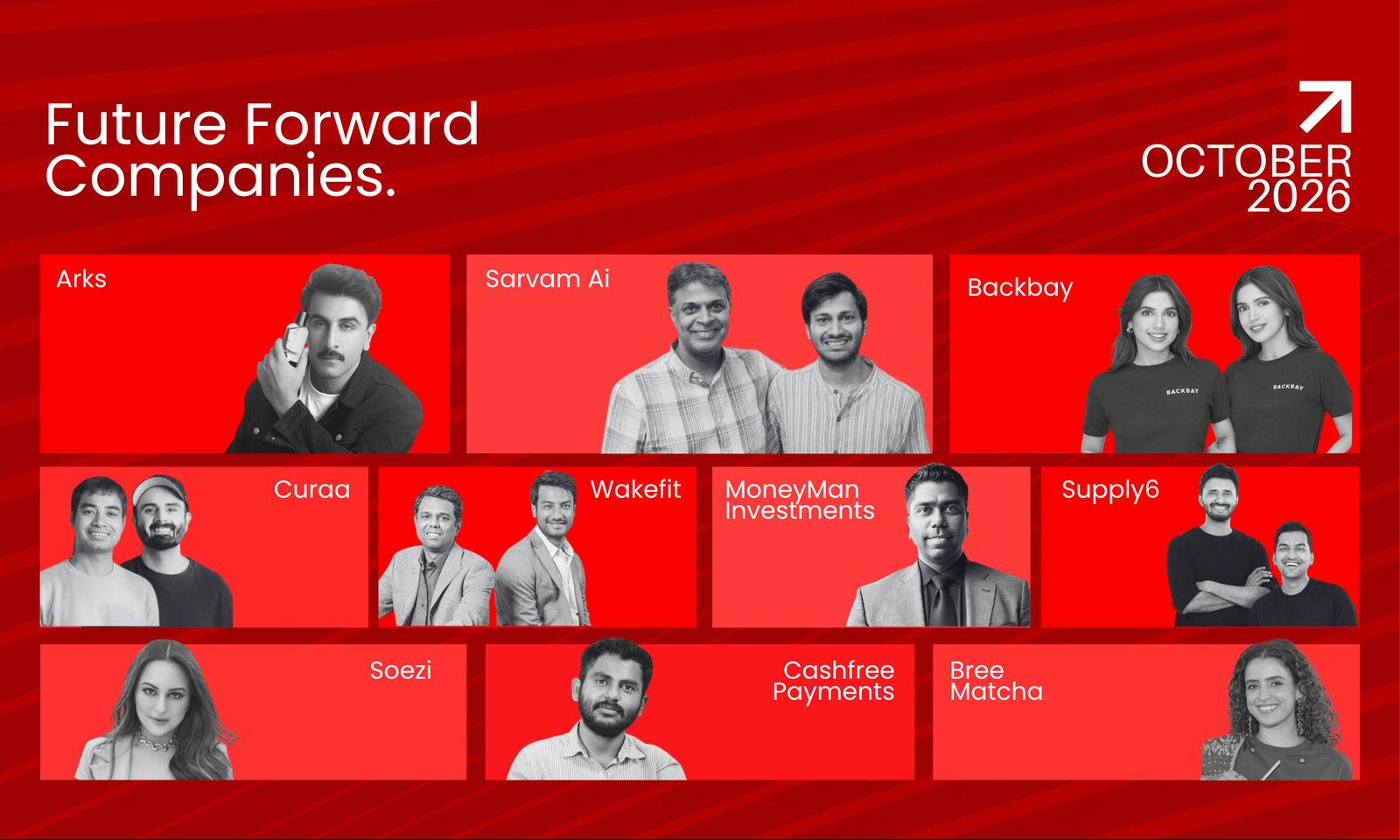
The next phase of business is rarely defined by one breakthrough. It is shaped by companies that identify changing consumer behaviour, emerging markets and new ways of creating value early.
Future Forward Companies brings together businesses that are moving in that direction. These are companies building new products, entering emerging categories, expanding into new markets or changing how established industries operate.
The Forward Tracker looks beyond the size of a company today. It focuses on the direction it is taking, the market it is entering and the opportunity it is building toward.
01. SARVAM AI
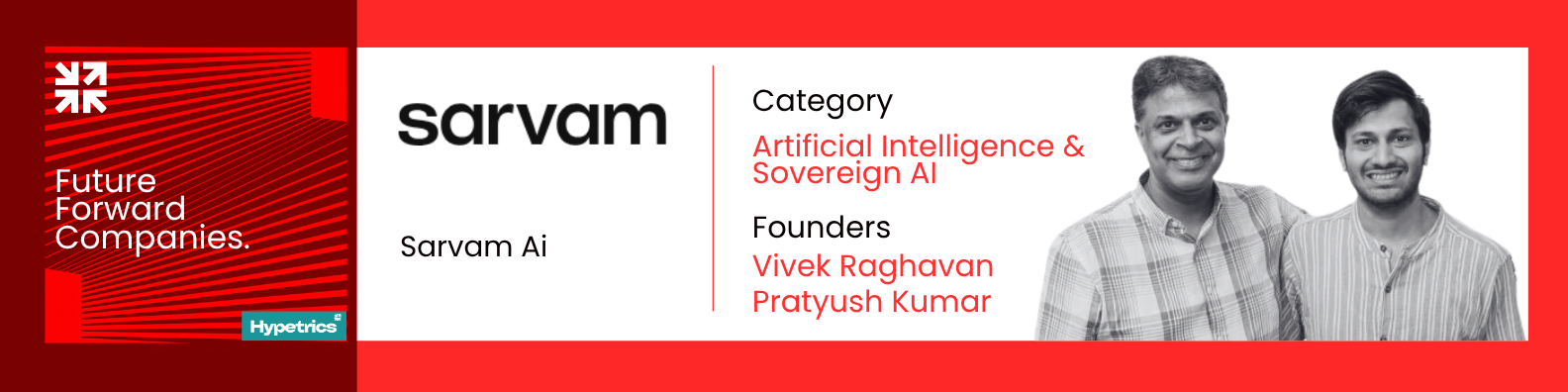
Category: Artificial Intelligence & Sovereign Ai
Sarvam AI is building an artificial intelligence platform around the specific requirements of the Indian market. Founded in August 2023 by Vivek Raghavan and Pratyush Kumar, the Bengaluru-based company is developing AI models, language technologies, enterprise applications and infrastructure designed for India’s scale and diversity.
The company’s work spans speech-to-text, text-to-speech, translation, document intelligence, conversational agents, coding tools and enterprise AI applications. Rather than focusing only on foundational models, Sarvam is building across multiple layers of the AI stack, with applications aimed at businesses, developers and government institutions.
India’s linguistic diversity is central to this approach. AI systems designed primarily around English and a limited number of major languages can face challenges when deployed across India’s broader linguistic landscape. Sarvam is developing models and applications that can work across this complexity, while also addressing practical requirements around voice, documents and enterprise workflows.
Another defining part of the company’s strategy is sovereign AI. Sarvam is focused on enabling Indian organisations to develop, deploy and govern AI systems within the country. This becomes increasingly relevant as businesses and public institutions consider questions around data, infrastructure, security and control.
The company entered a new phase in June 2026, when it raised $234 million in the first close of a $300 million Series B round at a $1.5 billion post-money valuation. The capital is being directed toward frontier AI research, computing capacity and models focused on areas including agentic AI, coding and cybersecurity.
Sarvam is now expanding beyond language models into voice, documents, workflows and AI agents. Its longer-term opportunity lies in building AI systems that can operate across India’s businesses and public infrastructure.
For Sarvam, the opportunity is not simply to bring AI to India. It is to build AI with India’s languages, infrastructure and institutional context at its core.
02. ARKS

Category: Lifestyle
ARKS is a contemporary lifestyle brand focused on creating products for everyday use. Its portfolio spans clothing, footwear, accessories and fragrance, with the brand gradually expanding beyond a single product category.
The starting point is everyday wardrobe essentials. T-shirts, shirts, trousers, denim, sweatshirts and sneakers form the core of the range. The products follow a relatively understated design language, with an emphasis on clean silhouettes, comfort and versatility.
ARKS is not positioned around seasonal fashion trends. The proposition is closer to building a consistent wardrobe where individual pieces can work across different settings and occasions.
This approach extends into the brand’s product development. Alongside apparel and footwear, ARKS has introduced fragrance through ARKS Day, creating another entry point into the same lifestyle proposition.
The brand’s identity is built around simplicity. Products are designed to be recognisable without relying heavily on visible branding. The focus remains on shape, material, utility and how the product fits into everyday life.
ARKS is also developing a broader product ecosystem. Its collections bring together different parts of the wardrobe rather than treating each category as a separate business. This creates room to expand into adjacent lifestyle categories while maintaining a consistent design language.
For consumers, the proposition is straightforward: fewer complicated choices, familiar aesthetics and products that can become part of everyday routines.
The larger opportunity for ARKS lies in extending this philosophy across more categories. As the product portfolio grows, the challenge will be maintaining the same visual and functional consistency across everything carrying the ARKS name.
ARKS is therefore building more than an apparel label. It is developing a lifestyle proposition where clothing is the starting point and everyday living is the broader category.
03. BACKBAY
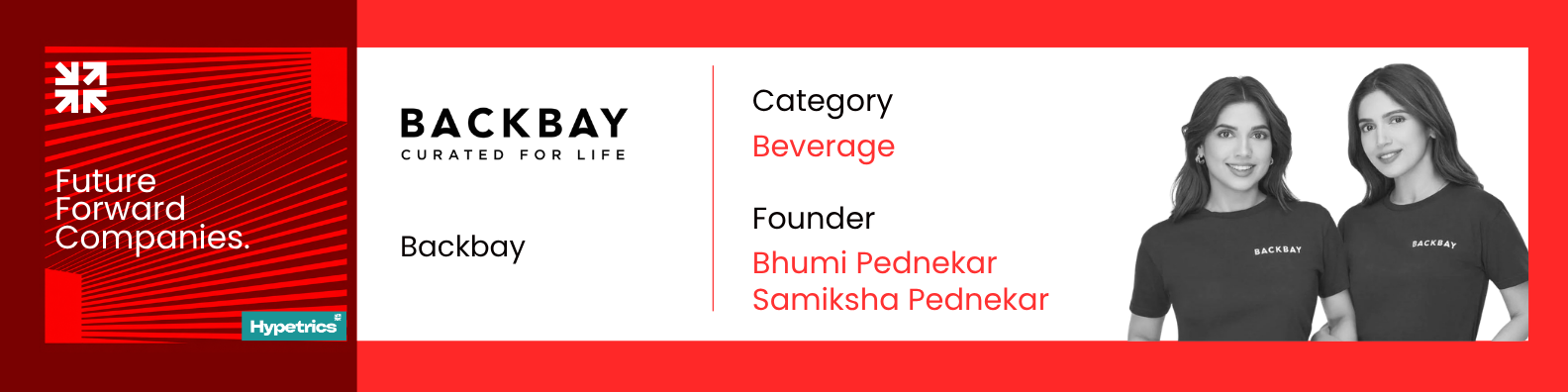
Category: Beverage
Backbay is a beverage brand focused on making everyday hydration more relevant to changing consumer preferences. Its starting point is packaged water, but the proposition extends into sourcing, formulation, packaging and the broader experience around consumption.
The brand’s first product, Backbay Aqua, is natural mineral water with naturally occurring minerals and electrolytes. It is positioned as a more considered alternative to conventional packaged water, with the product itself carrying a stronger focus on quality and composition.
Packaging is an important part of the proposition. Backbay uses paper-based cartons with plant-based caps instead of conventional plastic bottles. This gives the brand a distinct physical format while connecting its product with growing consumer interest in more responsible packaging.
The brand operates at the intersection of three categories: hydration, wellness and conscious consumption. This creates space to move beyond plain drinking water into a wider portfolio of beverages with simpler formulations and a stronger focus on everyday wellness.
Backbay’s approach is also visible in how it thinks about product development. Rather than adding complexity through multiple ingredients or aggressive functional claims, the brand focuses on making basic consumption more relevant through sourcing, packaging and product quality.
The initial range provides a focused entry into a highly established category. From here, the opportunity lies in building recognition around a consistent philosophy and extending that philosophy into adjacent beverage categories.
Water is a highly commoditised market. Differentiation therefore depends on more than the liquid inside the bottle. Brand identity, packaging, sourcing and consumer relevance become equally important.
Backbay is building around this opportunity, using hydration as its entry point into a larger consumer space where beverages, wellness and conscious consumption increasingly overlap.
04. CURAA

Category: Kitchen Appliances & Cookware
CÜRAA is building a kitchen and home brand around products designed specifically for the way Indian households cook. Founded by chef and content creator Sanjyot Keer and entrepreneur Neeraj Kumawat, the company develops its own range of kitchen appliances, cookware and everyday kitchen tools, combining functional design with an understanding of Indian cooking habits.
The brand’s portfolio includes mixer grinders and blenders, choppers, electric kettles, hand mixers, milk frothers, cookware, ceramic dinnerware and traditional kitchen accessories such as brass and steel masala danis. Its approach is built around addressing the practical demands of Indian kitchens, where ingredients, cooking techniques and preparation methods can differ significantly from those assumed by generic appliance designs.
CÜRAA has expanded rapidly since launching in 2024 and has reached more than 3 lakh households across India. In August 2026, the company raised ₹40 crore in Series A funding led by 3one4 Capital, with plans to strengthen product development, supply chain capabilities and its presence across direct, marketplace and quick-commerce channels.
The company is now moving beyond being a kitchen appliance startup toward a broader Indian home-kitchen brand, using product development and an India-first manufacturing approach to build appliances and kitchen essentials around everyday cooking needs.
05. WAKEFIT

Category: Home & Furniture
Wakefit began with a relatively focused idea: make better mattresses more accessible to Indian consumers. The company grew by building its own understanding of materials, manufacturing and customer needs rather than relying entirely on the traditional furniture retail model. Its original focus on mattresses has since expanded into a much broader home and furnishing business.
Today, Wakefit sells mattresses, beds, sofas, chairs, wardrobes, study tables, dining furniture, bedding and home décor, making the move from a sleep-focused D2C company to a wider home brand. Its growth has also brought a significant offline expansion, with more than 200 Wakefit stores listed across Indian cities on its current platform.
The company has built a vertically integrated model covering product design, engineering, manufacturing, distribution and customer experience. As of December 2025, Wakefit reported five manufacturing locations, 137 company-owned company-operated stores across 76 cities, and 1,692 multi-brand outlets across 453 cities.
That expansion is what makes Wakefit interesting beyond its mattress business. It is increasingly competing for a much larger share of the Indian home — moving from where people sleep to how they furnish and use their homes.
06. MoneyMan Investments

Category: Investment Research & Advisory
MoneyMan Investments focuses on a gap faced by senior corporate leaders. Professional success can create substantial income, but building and compounding personal wealth requires a different level of time, research and financial discipline.
The firm brings 27+ years of experience across Investment Banking, Investment Management and Asset Advisory to this problem. It is a SEBI-registered Corporate Research Analyst (INH000025382) serving CXOs, Directors and senior corporate leaders who want their personal investments managed with the same rigour applied to business decisions.
Its approach is framework-driven, with research, risk optimisation and capital protection forming central parts of the investment process. The objective is to participate meaningfully during favourable market conditions while limiting the impact of mistakes and drawdowns during difficult periods.
MoneyMan’s strategies are India-centric and designed for different investor profiles. The MoneyMan Absolute Momentum Multiplier is positioned for opportunistic investors seeking exposure to fast-moving stocks from leading sectors. The MoneyMan Factor Champions Compounder is designed for strategic investors looking to compound through fundamentally and technically strong stocks.
For pragmatic investors, the MoneyMan Sector Rotation Optimizer focuses on low-cost, low-risk ETFs to pursue passive outperformance through sector allocation.
Across these strategies, the firm places emphasis on trust, clarity, compliance and direct access to the fund manager. Its client base largely consists of CXOs and Directors who value a structured approach to managing personal capital.
The underlying proposition is to provide senior leaders with dedicated investment oversight without requiring them to track markets themselves.
MoneyMan positions this role as a personal, on-demand Chief Investment Officer, continuously monitoring macroeconomic conditions, markets, risks and opportunities.
For professionals whose careers are built around creating value, MoneyMan’s focus is on applying the same discipline to the capital accumulated along the way.
07. SUPPLY6

Category: Nutrition
Supply6 is a nutrition-focused brand built around making daily nutritional intake simpler and more convenient. Its proposition centres on providing multiple essential nutrients through a single, easy-to-consume format.
The brand addresses a familiar problem with modern diets: people may understand the importance of balanced nutrition, but busy routines can make it difficult to consistently plan and consume a wide range of foods and nutrients.
Supply6 approaches this through nutrition products designed for everyday consumption. The focus is on convenience without turning nutrition into a complicated routine, making the products relevant to consumers managing work, fitness and active lifestyles.
Its proposition sits across several growing consumer interests, including preventive health, functional nutrition, convenience and better daily dietary habits. Rather than focusing only on a single nutrient or benefit, the brand looks at nutrition more broadly.
The larger opportunity for Supply6 comes from changing consumer behaviour around health. Nutrition is increasingly becoming part of everyday decision-making, with consumers paying greater attention to what they consume, how products are formulated and whether they can fit easily into daily routines.
Supply6 is positioned within this intersection of nutrition and convenience, where the product has to deliver both nutritional relevance and practical usability.
The brand’s growth potential also lies in making nutrition accessible beyond a highly specialised fitness audience. As awareness around protein, micronutrients, functional ingredients and preventive health expands, everyday nutrition can become a larger consumer category.
Supply6 is therefore building around a straightforward proposition: make better daily nutrition easier to consume and easier to maintain.
08. SOEZI

Category: Beauty
SOEZI is a beauty and personal care brand focused on making nail styling more accessible, convenient and expressive for everyday consumers.
The brand’s proposition centres on press-on nails, offering consumers an alternative to traditional salon appointments. Its products allow users to change their nail looks at home, reducing the time and effort typically associated with professional nail services.
SOEZI approaches nails as more than a functional beauty routine. Its collections bring together different colours, finishes, shapes and designs, allowing consumers to treat nail styling as part of their personal appearance and everyday expression.
The at-home format also makes experimentation easier. Consumers can switch between designs without committing to a long salon process, creating a product experience that fits more naturally into changing occasions, outfits and preferences.
This places SOEZI at the intersection of beauty, convenience and self-expression. The category is also increasingly influenced by consumers who want salon-like results without the time, cost or commitment associated with regular appointments.
The brand has expanded its proposition beyond individual nail sets, developing products and accessories that support the broader nail-care and styling routine. This creates opportunities to build a larger beauty ecosystem around the initial press-on nail proposition.
SOEZI’s larger opportunity lies in making nail styling part of everyday beauty consumption rather than keeping it limited to occasional salon visits.
The brand is therefore building around a simple consumer proposition: bringing the creativity of nail art into a more convenient, accessible and at-home format.
09. CASHFREE PAYMENTS

Category: Fintech
Cashfree Payments is a financial technology company building payment and banking infrastructure for businesses operating in India and across global markets.
Its platform enables businesses to collect payments, make payouts, manage banking workflows and handle related financial operations through a unified technology layer. The focus is not limited to a single payment method, but on the infrastructure required to move money across different stages of a business transaction.
Cashfree supports multiple payment modes, including cards, bank transfers, UPI and other digital payment methods. Its payout infrastructure enables businesses to send money to customers, employees, vendors and other stakeholders.
The company has also expanded into areas such as identity verification, banking-as-a-service and cross-border payments, extending its role from payment processing toward broader financial infrastructure.
This becomes increasingly relevant as businesses move more of their operations online. Marketplaces, e-commerce companies, financial platforms, SaaS businesses and other digital-first organisations require payment infrastructure that can handle large transaction volumes while integrating with their existing technology systems.
Cashfree’s proposition is therefore centred on the infrastructure behind digital commerce rather than the consumer-facing payment experience.
Its broader opportunity lies in connecting different financial workflows through technology. Payments, collections, payouts, verification and banking services can increasingly operate as connected layers within a business’s technology stack.
The company is building around this infrastructure opportunity, with a focus on making financial operations more programmable, scalable and accessible for businesses.
For Cashfree Payments, payments are the starting point. The larger proposition is the financial infrastructure that allows digital businesses to move, manage and verify money at scale.
10. BREE MATCHA

Category: Everyday Wellness
Bree Matcha is a wellness and lifestyle brand built around making authentic Japanese matcha part of everyday routines in India.
Founded in 2025 by Sanya Malhotra, Dr. Kunal Shah and Siddharth Shah, the Mumbai-based brand combines Japanese matcha traditions with a more contemporary approach to wellness and daily consumption. Its matcha is sourced from Kagoshima, Japan, a recognised tea-growing region known for producing high-quality matcha.
The brand offers different grades designed around how consumers drink matcha. Ceremonial Matcha is positioned for traditional preparation, while Signature and Everyday Matcha are designed for regular consumption, including lattes, smoothies and recipes. Bree has also introduced flavoured matcha and instant latte formats.
This product range allows the brand to address different levels of familiarity with matcha. Someone discovering the category can begin with an everyday format, while more experienced consumers can explore premium ceremonial varieties.
Bree Matcha also places emphasis on sourcing and product quality. Its organic varieties carry JAS Organic certification, while batches undergo third-party testing for quality and safety. The brand focuses on matcha without unnecessary fillers or additives in its organic varieties.
The broader proposition goes beyond selling tea powder. Bree Matcha is positioning matcha as a lifestyle ritual associated with balanced energy, focus and everyday wellness.
Its portfolio is already extending into accessories, kits, flavoured products and ready-to-prepare formats, creating multiple ways for consumers to engage with the category.
The opportunity for Bree lies in making matcha less unfamiliar and more habitual for Indian consumers.
Rather than treating matcha as an occasional premium beverage, the brand is building around a simpler idea: bringing Japanese matcha into the everyday rhythm of modern Indian lifestyles.
The companies featured in Future Forward Companies operate across different categories, business models and stages of growth. Some are entering markets that are still taking shape. Others are approaching established categories with new products, technologies, business models or consumer propositions.
What connects them is not their current size or visibility. It is the direction in which they are building.
Some are creating new categories around changing consumer behaviour. Others are taking familiar products into new customer segments, markets and use cases. Some are developing infrastructure that could enable entirely new businesses, while others are changing how existing industries operate.
That makes their journeys worth following beyond individual milestones. Product launches, new markets, distribution expansion, capital raised and changes in consumer adoption can each offer signals about where a category may be heading.