



Consumers are not exploring more options anymore. They are narrowing choices by following what others are already choosing. This shift is subtle. It does not appear in how platforms present options, but it is visible in how people actually move through them.
Choice has expanded across every category. More products are available online, retail shelves are more crowded than before, and service platforms list hundreds of options in a single screen. Access is no longer the constraint. Decision-making is. Consumers are not evaluating everything available to them. They are scanning for what feels already accepted.
Data reflects this compression clearly. Between 70% to 78% of consumers read reviews before purchasing. Products with more than 50 reviews see nearly double the conversion. Once review counts cross 100, decision time reduces by 30% to 40%. Around 60% of consumers also check how recent those reviews are. Listings with activity in the last few days show close to 20% higher conversion. At the same time, attention is highly concentrated. Nearly 70% to 80% of clicks happen on first-page listings, and most purchases occur within the first few visible options.
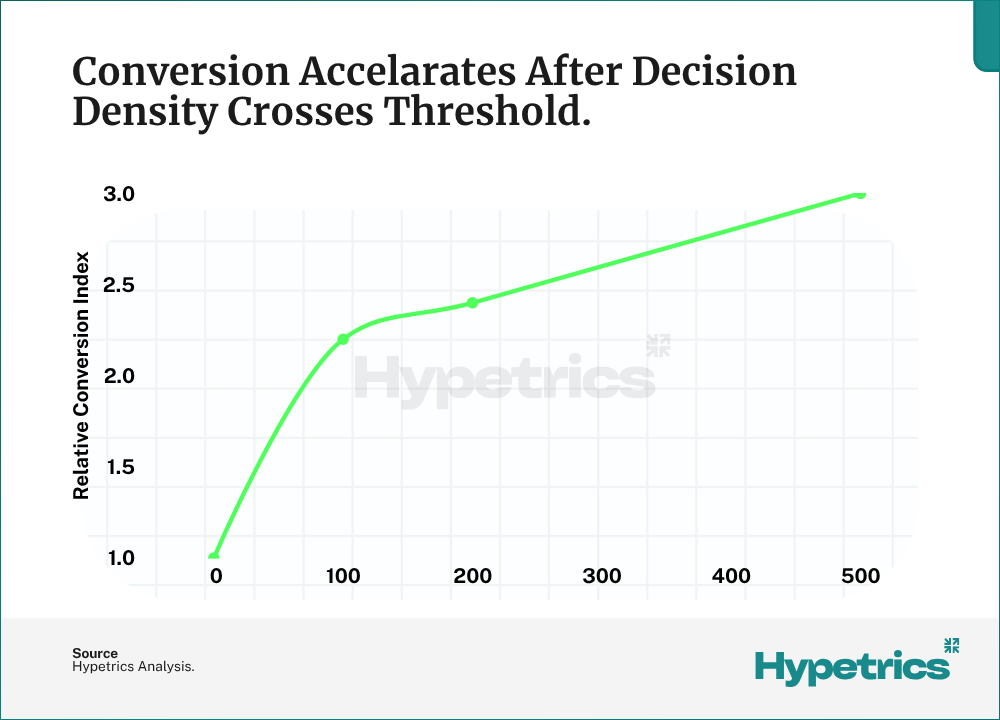
Consumers are not trying to find the best option. They are trying to avoid making a wrong one. This changes the structure of decision-making. The first filter is not product quality but how many others have already chosen something. Options with higher activity feel safer. Low activity creates hesitation. This is decision density shaping behavior, where the volume of previous decisions becomes a shortcut for new ones.
The second layer is time. Consumers are not only checking how many people chose something. They are checking if people are still choosing it. Recent activity signals relevance, while older validation weakens confidence. Trust becomes time-linked. Two products with similar ratings can perform differently simply because one shows recent validation while the other does not.
The third layer is frequency. Consumers notice how often validation is happening. When reviews or activity keep coming in, it creates a sense of momentum. When activity slows down, it signals fading interest. This pattern is visible across environments. Online, it appears in trending products. In retail, it shows up as fast-moving shelves. In services, it reflects in frequently booked options. Proof velocity becomes a signal of demand.
Consumers are not relying on one signal. They are scanning multiple cues together. Ratings, number of reviews, recent activity, photos, videos, and platform highlights all play a role. Each signal reduces uncertainty slightly. Together, they reduce it enough to enable a decision. The process feels quick, but multiple checks are happening within seconds.
The actual decision process is not selection-first. It is elimination-first. Consumers remove options that feel uncertain. Products with too few reviews, no recent activity, or lack of visible usage are filtered out quickly. Selection happens only after this elimination stage, and from a much smaller set of options.
This behavior is consistent across categories. In product purchases, reviews and activity guide selection. In retail, movement and crowding influence perception. Products that appear frequently picked feel safer to choose. In services, recent bookings and ratings drive decisions. Providers with ongoing activity get selected faster. Across all environments, the same logic applies. If others are choosing it now, it feels safer to choose.
Differences exist across consumer segments, but the underlying pattern remains. Younger consumers rely more on visible behavior and peer signals. Older consumers rely more on consistency and patterns over time. Female consumers tend to validate more deeply across multiple signals, while male consumers tend to decide faster using summary indicators. Despite these differences, all groups converge on the same mechanism of following visible selection patterns.
This shift changes how markets behave. Having more options is no longer an advantage. Being among the visible and validated options is. Platforms play a central role in shaping this. Through ranking systems, sorting logic, and highlighted sections, they influence what gets seen first. Consumers operate within this structured visibility, which amplifies already popular options.
Demand begins to concentrate. A small set of options captures most of the selection across categories. This is visible in e-commerce, retail environments, and service platforms. Once an option gains early traction, it continues to gain more. This creates a compounding effect where visibility leads to selection, and selection reinforces visibility.
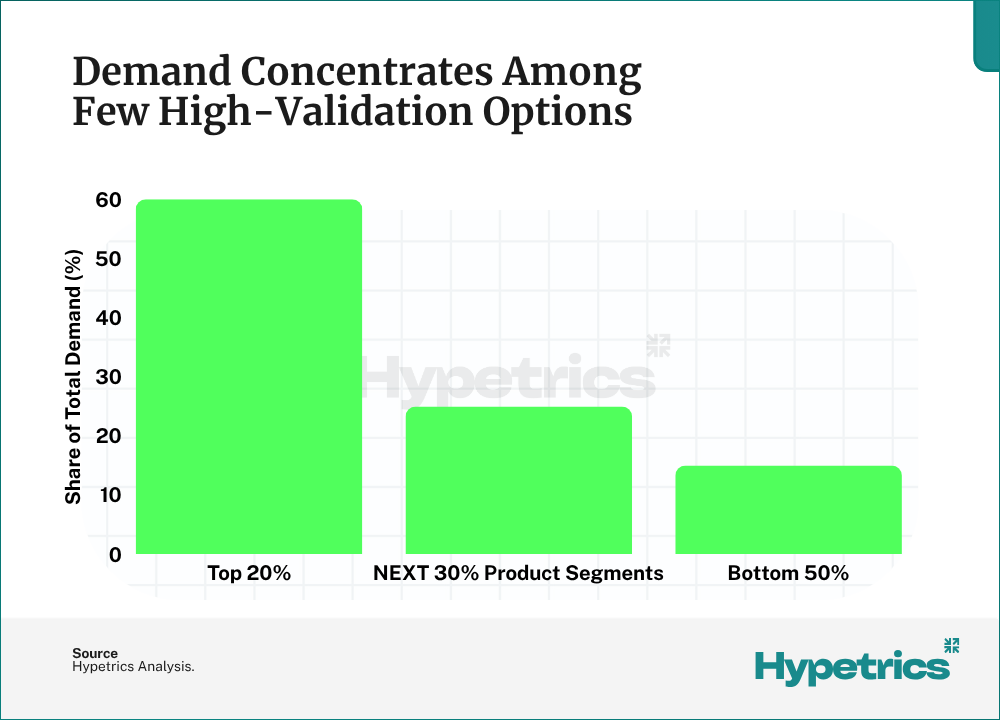
At the same time, entry becomes harder. New options face a visibility barrier. Without early validation, they do not get selected. Without selection, they cannot generate validation. This creates a closed loop. Breaking into this loop often requires external push, typically through paid visibility.
This also impacts cost structures. Options with strong validation depend less on paid acquisition because they convert through visible trust signals. Options without validation rely heavily on advertising, increasing their cost of conversion. Validation becomes a functional input into growth, not just an outcome.
This behavior is not temporary. It is becoming the default decision system. Consumers are moving away from exploration and towards guided selection. They are relying more on collective behavior and less on independent evaluation. Decision time continues to reduce, but the number of signals being checked within that time increases.
Over time, outcomes become more predictable. Options with high activity, recent validation, and continuous engagement will continue to dominate. Others will struggle to enter consideration. Consumers are not choosing from all available options. They are choosing from what feels already chosen. Choice has expanded, but selection has narrowed.