


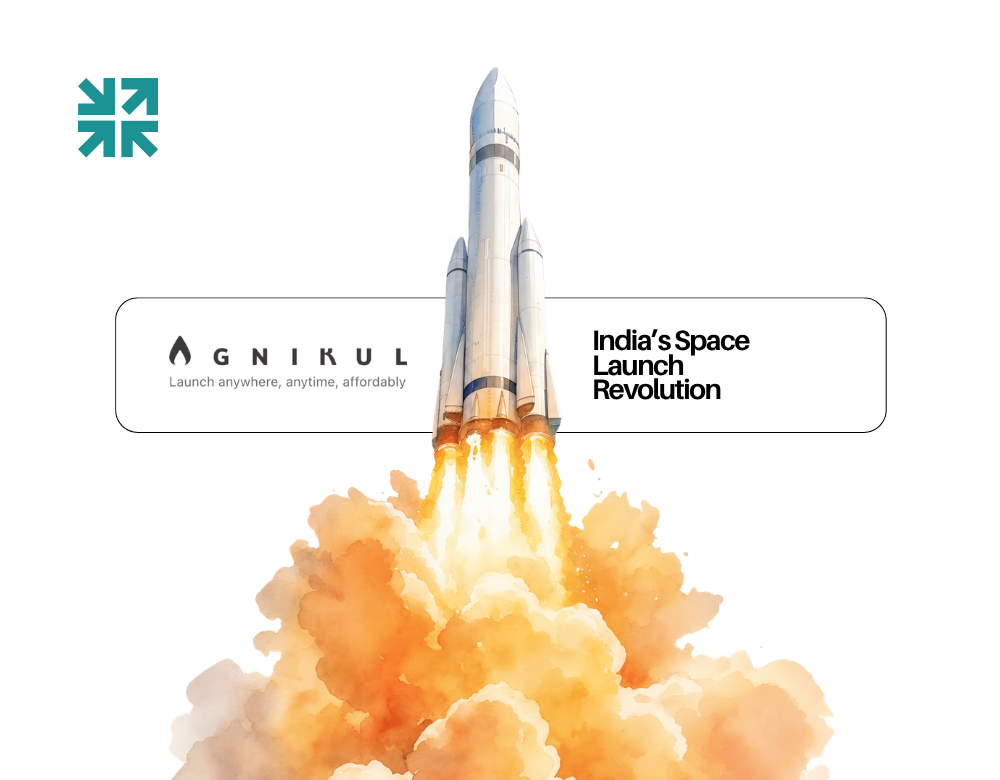
India’s private space industry is moving into its next phase. The first phase was about proving that private companies could design and build sophisticated space hardware. The next is about building systems that can operate repeatedly, serve commercial customers, reduce the friction of getting payloads into orbit and eventually create an economically sustainable launch business.
Agnikul Cosmos is now operating at that transition point.
The Chennai-based space technology company, founded in 2017, began with a focused question: why should small-satellite customers have to fit their missions around the schedules and requirements of large launch vehicles? Its answer was to build a launch architecture around the payload rather than force the payload to adapt to the rocket.
Nearly a decade later, that idea has expanded into a much larger technology and infrastructure proposition. Agnikul is developing orbital-class launch vehicles, manufacturing its own propulsion systems, operating its own private launch infrastructure, investing in reusable-stage technology and exploring the possibility of using space itself as infrastructure for applications such as orbital computing.
For Hypetrics, the important story is not simply that Agnikul has built a 3D-printed rocket engine. The bigger story is how the company is attempting to turn flexibility, vertical integration and reusability into the foundation of a commercial space transportation business.
The Problem Agnikul Set Out to Solve
Agnikul’s origin can be traced to a change taking place in the satellite industry. Satellites were becoming smaller, more specialised and more numerous, but launch systems were not necessarily evolving at the same pace.
A small satellite operator could build a sophisticated spacecraft and still face a fundamental commercial constraint: getting that spacecraft into the precise orbit required at the right time.
Traditional rideshare missions solve part of the cost problem because multiple payloads share one rocket. But the trade-off is reduced control. The primary mission determines the launch schedule, destination and often the broader mission architecture, leaving smaller customers to work around someone else’s requirements.
Agnikul was built around the alternative.
The company’s stated philosophy is that launches should become customer-driven rather than launch-vehicle-driven. Its current platform allows a prospective customer to specify variables including launch location, orbital inclination, payload mass, orbital altitude and payload integration requirements before building the proposed mission architecture.
That changes the commercial proposition.
Instead of asking a customer, “Which rocket can carry your satellite?”, the underlying question becomes, “What launch configuration best fits your mission?”
That distinction has shaped much of Agnikul’s technology roadmap.
The Technology Strategy: Simplify the Rocket by Changing How It Is Made
Rocket engines are among the most demanding components in aerospace. They have to withstand extreme temperatures, pressures and mechanical forces while maintaining highly controlled combustion.
Conventional engine manufacturing can involve a large number of individual components, manufacturing processes and joining operations.
Agnikul took a different approach.
Its Agnilet propulsion system was developed as a single-piece, 3D-printed semi-cryogenic rocket engine. The company designs and manufactures the engine in-house using Inconel, integrating components such as the injector and cooling channels into the printed structure rather than treating them as a large collection of separately manufactured components.
The significance is not simply that the engine comes from a 3D printer.
The deeper advantage Agnikul is pursuing is manufacturing simplification.
Fewer individual components can potentially mean fewer joints, fewer interfaces, fewer manufacturing operations and a more standardised production process. That matters enormously when a launch company wants to move from making one technically successful vehicle to producing multiple flight-ready vehicles.
The company has also developed its own post-print processes, including CT scanning, heat treatment, grinding and cleaning.
This is part of a broader pattern in Agnikul’s strategy: control more of the technology stack rather than relying on a fragmented external supply chain.
That philosophy extends beyond the engine.
The company says its avionics architecture has been designed around the modular nature of its launch vehicle, while propulsion components are also developed in-house.
Agnibaan: A Launch Vehicle Designed Around Mission Flexibility
At the centre of Agnikul’s commercial ambition is Agnibaan, its orbital-class launch vehicle.
Agnibaan is designed to carry small satellites into low Earth orbit, with the company building flexibility into the vehicle through configurable first-stage engine arrangements.
The current product information lists a vehicle mass of approximately 490 kg and an orbit around 680 km, while emphasising that the vehicle architecture can be configured according to mission requirements.
This modularity is more significant than it may initially appear.
A launch vehicle cannot simply remove an engine and automatically become a smaller rocket. Changing engine count affects thrust-to-weight ratio, vehicle controllability, stability and aerodynamic behaviour. Agnikul says it has engineered the vehicle so different configurations can maintain appropriate flight characteristics.
The company’s second-stage architecture uses the Agnite vacuum-optimised engine, based on the same broader propulsion philosophy. Agnikul also describes electric-pump-fed propulsion as a way of improving propellant utilisation while enabling configurable engine clustering.
In business terms, the objective is straightforward: avoid building a completely different rocket for every customer requirement while still maintaining enough flexibility to serve different payload classes.
That makes the launch vehicle itself a configurable platform.
SOrTeD Was More Than a Test Flight
Before Agnibaan can become a commercial orbital launcher, Agnikul needed to validate its technologies under actual flight conditions.
That happened on 30 May 2024, when the company launched Agnibaan SOrTeD Mission-01 from Agnikul Launchpad-01 at Sriharikota.
The mission became an important milestone because several pieces of the company’s architecture came together in one operation: indigenous propulsion, a privately developed launch facility, flight operations and coordination with the Indian space ecosystem.
The launch vehicle used for the mission was sub-orbital rather than an orbital commercial launcher. The company initially developed SOrTeD as a technology demonstrator, but following the successful mission it repositioned the vehicle as a standalone product for low-altitude and near-space applications.
Agnibaan SOrTeD can carry payloads of up to 30 kg and is positioned for experimentation, technology validation and other missions where reaching near-space environments is more important than establishing orbit.
This creates another potential layer in Agnikul’s portfolio.
The company is not necessarily dependent on waiting for its full orbital vehicle to become commercially operational before offering a flight product.
The Launchpad Is Part of the Business Model
One of Agnikul’s most important strategic decisions was to build its own private launch infrastructure.
The company established Agnikul Launchpad-01 at the Satish Dhawan Space Centre in Sriharikota and describes it as India’s first private launchpad. It also established a dedicated mission-control centre associated with the launch infrastructure.
This matters because launch frequency is constrained not only by rocket manufacturing but also by infrastructure.
If the company wants to offer customers more flexibility, it needs control over a larger portion of the launch process.
Agnikul’s approach is therefore becoming vertically integrated across several layers:
- Engine Development
- Propulsion Manufacturing
- Vehicle Integration
- Launch Infrastructure
- Mission Operations
- Recovery and Requalification
The company is also developing transportable mission-control capabilities and describes its launch system as mobile and configurable. Its technology platform is designed with the possibility of operating from different launch locations rather than being permanently tied to one physical architecture.
That is strategically important because launch economics are influenced by geography as well as engineering.
Agnikul states that selecting an appropriate latitude can potentially reduce launch costs by as much as 30%, demonstrating why the company views launch location as part of mission design rather than simply an infrastructure decision.
The Business Is Becoming a Manufacturing Company
Agnikul’s future cannot be built around engineering prototypes alone.
To compete in commercial space transportation, the company needs repeatable manufacturing.
This has led to the development of Agnikul Rocket Factory-01, where the company manufactures 3D-printed rocket engines, alongside its large-format additive manufacturing capabilities. It has also achieved AS9100D certification, an aerospace quality-management standard, while developing larger-scale metal additive manufacturing infrastructure.
This is a critical part of the story because aerospace startups often face a less visible problem after proving their core technology: how to manufacture the same product repeatedly without losing quality or economics.
The manufacturing infrastructure Agnikul is building is therefore as important to its long-term business model as the rocket itself.
The company is effectively trying to create a production system in which additive manufacturing is not an isolated technology demonstration but part of the normal industrial process.
2026: The Strategy Is Shifting Toward Reusable Launch
This is where Agnikul’s story becomes considerably more ambitious.
The company is no longer looking only at how to launch a rocket. It is increasingly focused on how to make parts of that rocket come back and fly again.
In September 2026, Agnikul inaugurated two new facilities in Chennai:
Stage Testing & Inspection Facility (STIF) and Pressurant Tank Realisation, Over-wrapping and Outfitting Facility (PROOF).
STIF is designed to test reusable rocket stages under flight-like conditions and support post-flight inspection and requalification. The facility supports thrust levels ranging from 1 kN to 200 kN, LOX sub-cooling down to 73 K, and full-duration burns of up to 150 seconds.
PROOF focuses on pressure-vessel manufacturing and related processes. The company’s expansion of these capabilities shows that reusability is no longer being treated as a future concept sitting on a presentation slide. It is becoming an engineering and manufacturing programme with dedicated infrastructure.
That has major implications for the economics of the company.
For an expendable rocket, each launch consumes a vehicle.
For a reusable architecture, the economic objective changes: the company seeks to spread the cost of major vehicle components across multiple missions.
The objective is not simply technological prestige. It is higher launch frequency and better capital utilisation.
Mission-02 Could Define Agnikul’s Next Phase
The company’s next major flight programme is Mission-02.
The mission is intended to move Agnikul beyond its 2024 sub-orbital demonstration and into a more ambitious test of reusable launch architecture. The company is working toward recovery of the launch system’s lower-stage hardware while also pursuing an extended operational role for the upper stage.
This is a substantial change in philosophy.
Conventional launch missions treat the upper stage primarily as a delivery mechanism: once its job is finished, the mission is effectively over.
Agnikul is exploring a model where the upper stage can continue to provide value after deployment.
That creates the possibility of turning rocket hardware into orbital infrastructure rather than treating it entirely as consumable launch hardware.
From Rocket Company to Space Infrastructure Company
One of the most interesting developments in Agnikul’s roadmap is its collaboration with NeevCloud around space-based data-centre infrastructure.
The concept involves using an orbital platform to host computing infrastructure in space. The first pilot has been targeted for 2026, subject to mission readiness and technical execution.
The significance is bigger than the individual project.
If a launch vehicle can place a platform into orbit and that platform can subsequently host additional functionality, the company’s addressable opportunity potentially expands beyond launch services.
Instead of generating revenue only when a rocket takes off, future business could involve several layers:
1.Launch
2. Orbital deployment
3. Hosted Infrastructure
4. Mission services
5. Recurring space-based applications
This is still an emerging market, and the commercial economics and engineering requirements need to be proven. But strategically, it shows how Agnikul is thinking about its technology platform.
The company is attempting to move from being a company that delivers things to space to one that can potentially help operate infrastructure in space.
Funding Is Supporting a Much Larger Build-Out
Agnikul’s expansion has been supported by institutional and strategic capital.
In November 2025, the company raised approximately $17 million (around ₹150 crore) in a funding round at a reported valuation of approximately $500 million.
The round included participation from investors such as Advenza Global, Atharva Green Ecotech, HDFC Bank, Artha Select Fund, Prathithi Ventures and 100X.VC. The stated objectives included expanding manufacturing capacity, advancing the stage-recovery programme, increasing launch frequency and developing a larger integrated space campus.
A further development came in March 2026, when the Tamil Nadu Industrial Development Corporation committed ₹25 crore of equity investment in Agnikul under the state’s startup investment framework.
The company has also been associated with plans for a significantly larger integrated space campus in Tamil Nadu.
The pattern is clear: Agnikul is moving from a startup operating primarily around laboratory and incubation infrastructure towards a capital-intensive industrial model.
Revenue Is Not Yet the Most Meaningful Measure of the Company
For a conventional software or consumer startup, revenue growth provides an immediate indication of commercial traction.
A space-launch company requires a different reading.
Agnikul is currently investing heavily in infrastructure, testing systems, manufacturing capability and technology qualification. The commercial orbital-launch business has not yet reached mature recurring operations.
The more relevant indicators at this stage are therefore:
technology readiness, launch milestones, manufacturing capacity, customer pipeline, funding available for execution, launch frequency and progress toward reusability.
Once orbital launches become repeatable, revenue quality will become substantially more important.
The Customer Is Changing Too
Agnikul is building for a customer base that is broader than the traditional government space programme.
Potential customers include satellite companies, Earth-observation businesses, communication companies, research organisations, technology developers and organisations requiring specialised orbital missions.
The common requirement is not necessarily the same payload size.
It is greater control over the mission.
That is why Agnikul’s customer proposition emphasises dedicated launches, mission-specific vehicle sizing, launch timing and orbital requirements. The company says that even small payloads can receive dedicated missions without waiting for shared rides and positions its service around shorter launch timelines.
For commercial customers, that flexibility can have an economic value of its own.
A satellite waiting several additional months for a compatible rideshare mission is not simply experiencing a scheduling inconvenience. The delay can affect revenue generation, constellation deployment, technology validation and the timing of downstream contracts.
Agnikul is therefore selling something broader than transportation to space.
It is selling control over when and where a customer reaches orbit.
The Competitive Question Is No Longer “Can India Build a Rocket?”
India’s private space ecosystem has changed dramatically.
By 2026, hundreds of startups are participating across launch vehicles, satellite manufacturing, Earth observation, propulsion, space electronics, data and other parts of the space economy. The sector is increasingly shifting from technology demonstration towards commercialisation.
That means Agnikul’s competitive challenge has changed.
A few years ago, successfully building and firing a private rocket engine was itself a major differentiator.
Today, the competitive questions are harder:
Can the vehicle launch reliably?
Can it launch repeatedly?
Can the company manufacture hardware fast enough?
Can it keep launch costs competitive?
Can it offer customers predictable schedules?
Can it recover and requalify vehicle stages?
Can it translate technological flexibility into commercial flexibility?
And ultimately, can it create a business model that becomes stronger as flight frequency increases?
These are the metrics that will determine Agnikul’s next chapter.
FY2027 Could Become the Critical Commercial Transition
Agnikul’s current published launch roadmap points to two orbital missions from Agnikul Launchpad-01:
Q1 2027: up to 100 kg to LEO
Q2 2027: up to 300 kg to LEO
Both are currently listed as scheduled.
These missions matter because they represent the proposed transition from demonstration to commercial orbital capability.
If Agnikul executes successfully, its proposition changes fundamentally.
The company would no longer be primarily proving propulsion technology. It would be demonstrating a complete launch-service system capable of carrying customer payloads to orbit.
From there, the next challenge would be cadence.
One successful orbital launch establishes capability.
A series of successful launches establishes a business.
The Three-Year Strategic Picture
Looking ahead from September 2026, Agnikul’s strategy can be understood through three interconnected priorities.
1. Establish orbital launch capability
The immediate requirement is to move from the successful 2024 SOrTeD demonstration to operational orbital missions using Agnibaan.
2. Build reusability into the economics
Recovery is not being pursued simply as an engineering achievement. The strategic objective is to lower the effective cost of hardware per mission and increase the frequency with which launch assets can be used.
3. Create value beyond the launch
The orbital-platform concept introduces another possibility: using the launch system to enable infrastructure and services once the payload reaches space.
Together, these three priorities point towards a company that wants to control a meaningful portion of the space transportation and infrastructure stack.
What Agnikul Could Look Like by FY2030
Agnikul’s FY2030 opportunity is larger than becoming another rocket manufacturer.
A successful version of the company could operate as an integrated space-transportation platform with several layers.
At the first layer would be launch services: dedicated missions for small satellites and specialised payloads.
Above that would be launch infrastructure: private launch facilities, mission-control systems and potentially transportable launch capabilities.
The third layer would be reusable hardware, enabling multiple missions from the same major vehicle components.
The fourth could be orbital infrastructure, where extended upper stages or dedicated platforms become useful after deployment.
And alongside all of it would be in-house manufacturing, particularly additive-manufactured propulsion systems and critical aerospace components.
That would make Agnikul less comparable to a traditional aerospace contractor and more comparable to a vertically integrated space infrastructure company.
The Real Test Ahead
The most difficult phase of Agnikul’s journey is arguably beginning now.
The engineering ambition is established. The company has demonstrated a 3D-printed rocket engine, launched a sub-orbital vehicle, established private launch infrastructure and developed increasingly sophisticated manufacturing and testing capabilities.
The next test is repetition.
Commercial space companies are ultimately judged by whether they can transform exceptional engineering into repeatable operations.
Agnikul’s biggest opportunity lies in the possibility that several of its technological decisions reinforce one another.
3D printing can simplify propulsion manufacturing.
Simplified manufacturing can support higher production rates.
Higher production rates can support greater launch frequency.
Modular vehicles can support more customer configurations.
Reusable stages can improve vehicle economics.
Dedicated launch infrastructure can improve scheduling flexibility.
And orbital platforms can create opportunities beyond the launch itself.
That is the strategic flywheel Agnikul is attempting to build.
Agnikul Cosmos
Founded: 2017
Headquarters: Chennai, Tamil Nadu
Core business: Space transportation, launch vehicles and propulsion technology
Key products: Agnibaan, Agnibaan SOrTeD, Dhanush
Core technology: Single-piece 3D-printed semi-cryogenic rocket engines, modular launch architecture, in-house avionics and propulsion
Major demonstrated milestone: Agnibaan SOrTeD Mission-01, 30 May 2024
Launch infrastructure: Agnikul Launchpad-01, SDSC SHAR
Major funding round: $17 million in 2025 at a reported $500 million valuation
2026 development: New STIF and PROOF facilities for reusable-stage testing, inspection and pressure-vessel manufacturing
Published orbital roadmap: Q1 2027 and Q2 2027 missions, targeting up to 100 kg and 300 kg respectively to LEO
Strategic direction: Orbital launch, reusable launch systems, scalable manufacturing and space-based infrastructure
The Hypetrics Perspective
Agnikul Cosmos is entering a phase where its biggest competitive advantage may no longer be any single piece of technology.
Its advantage could be the integration of multiple technologies and capabilities into one commercial system.
The company started with an answer to a very specific problem in the small-satellite market: make access to orbit more flexible. Today, that proposition has expanded into a broader ambition—build launch vehicles that can be customised, manufacture critical propulsion systems internally, operate dedicated launch infrastructure, recover major vehicle stages and eventually use deployed hardware as infrastructure in space.
That makes reusability and commercial launch cadence the two milestones to watch most closely through FY2027–FY2030.
The 2024 SOrTeD mission proved that Agnikul could take its technology from the factory to the launchpad and into flight.
The next stage is much harder.
Can it turn that achievement into a repeatable commercial launch system?
That is the question that will define Agnikul Cosmos over the next several years—and potentially determine whether its 3D-printed-engine innovation becomes a successful aerospace product or the foundation of something much larger.