



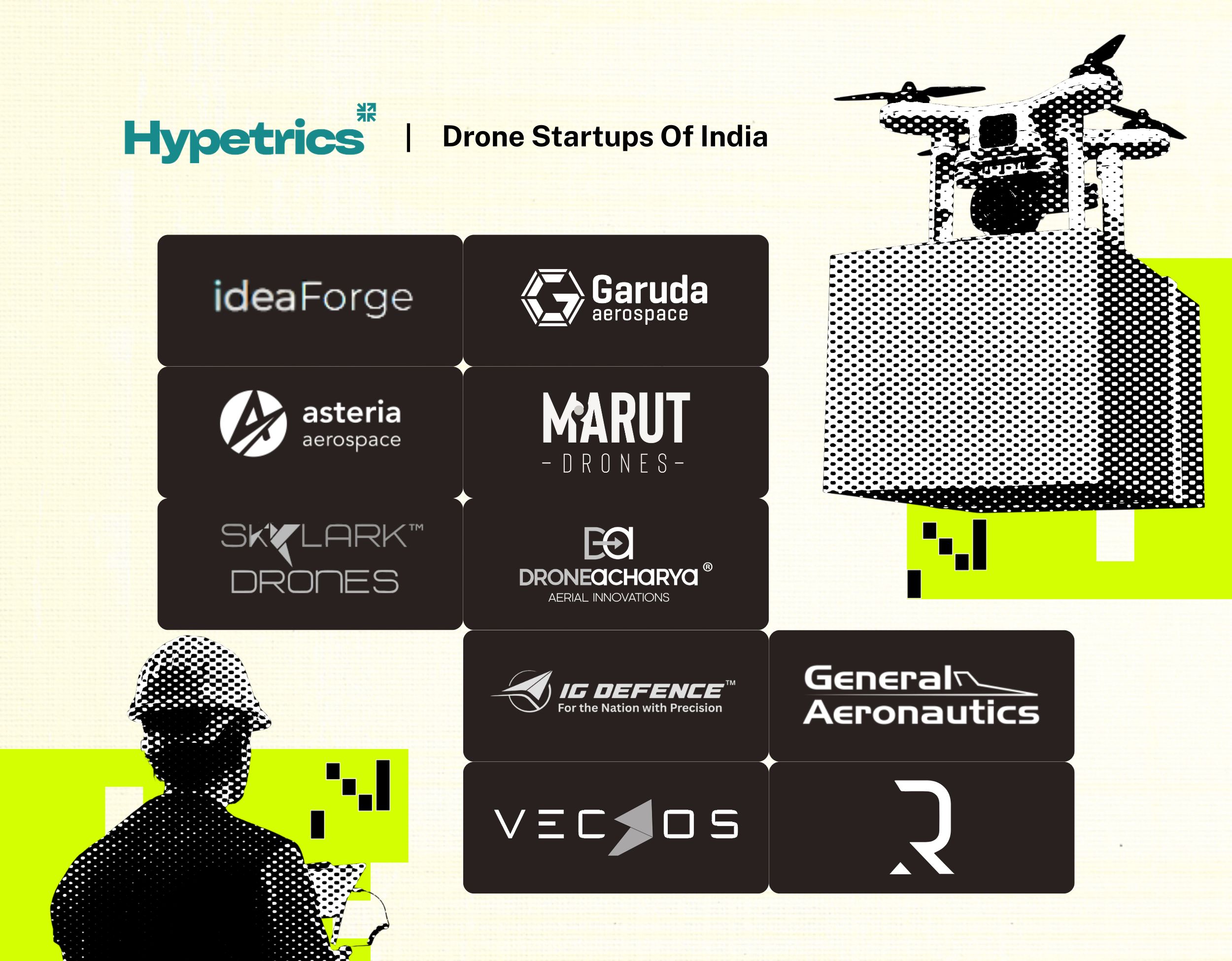
India’s drone ecosystem is starting to look more real.
A few years ago, most of the activity was around policy announcements, pilot projects, and early experimentation. Companies were testing where drones could fit. That phase is slowly passing. What is visible now is actual usage across sectors. Agriculture teams are using drones for spraying and crop monitoring. Infrastructure companies are relying on them for mapping and inspections. Defense applications are becoming more structured and consistent.
The numbers also reflect this shift. India today has 500+ drone startups operating across different segments. The government has committed over ₹120 crore under the PLI scheme for drones, and the broader drone market in India is expected to reach $1.8–2 billion by 2026. These are not just projections. They indicate that the ecosystem is moving from early validation to scale.
What is changing underneath is equally important. Drones are no longer being seen as standalone products. They are being used to solve specific operational problems. Faster coverage. Better visibility. Reduced manual effort. This is what is driving adoption.
At the same time, companies in this space are evolving. Some are building hardware. Some are running large-scale deployment operations. Others are focused on data, analytics, and training. A few are moving toward autonomous systems. This mix shows that the market is not forming as one category. It is developing as multiple layers at the same time.
IdeaForge
Category: Defense UAV Systems
Layer: Tactical Infrastructure
Founded In: 2007
Founders: Ankit Mehta, Rahul Singh, Vipul Joshi, Ashish Bhat
Funding Raised To Date: $50M+
Investors: Florintree Advisors, Qualcomm Ventures, Infosys
Headquarters: Mumbai
ideaForge operates in environments where reliability matters more than scale. Its drones are used by defense and security agencies for surveillance and reconnaissance. The company focuses on building systems that can function in high-risk conditions with consistent performance. This creates a different kind of positioning. It is less about volume and more about long-term integration into government and defense infrastructure.
Garuda Aerospace
Category: Drone-as-a-Service (DaaS)
Layer: Operational Deployment
Founded In: 2015
Founders: Agnishwar Jayaprakash
Funding Raised To Date: $30M+
Investors: MS Dhoni Family Office, Venture Catalysts
Headquarters: Chennai
Garuda Aerospace is focused on large-scale deployment rather than just manufacturing. Its drones are used across agriculture, surveillance, and enterprise operations. The company runs fleet-based services, especially in agri spraying, where frequency of use is high. Over time, it has also started moving toward defense manufacturing, indicating a shift from service execution to a more strategic role in the ecosystem.
Skylark Drones
Category: Drone Data Platform
Layer: Intelligence Infrastructure
Founded In: 2014
Founders: Amar Metta, Neel Mehta
Funding Raised To Date: $8M+
Investors: Info Edge Ventures, IAN Fund
Headquarters: Bengaluru
Skylark approaches drones from a data perspective. The company focuses on converting aerial inputs into usable insights for industries like mining and infrastructure. Its platform helps enterprises make decisions based on real-time data rather than manual inspection. This reflects a broader shift in the market, where drones are becoming tools for data collection, while the real value sits in analysis and intelligence.
IG Drones
Category: Drone Intelligence & Defense Tech
Layer: AI + Defense Infrastructure
Founded In: 2018
Founders: Bodhisattwa Sanghapriya, Om Prakash
Funding Raised To Date: $5M+
Investors: India Accelerator, Venture Catalysts
Headquarters: Delhi
IG Drones operates at the intersection of defense, mapping, and AI-driven analytics. The company is involved in high-impact deployments including border surveillance and infrastructure mapping for government projects. Its focus is not limited to drone manufacturing. It builds intelligence systems that process aerial data for decision-making. This positions it closer to a defense-tech and geospatial intelligence layer rather than a conventional drone company.
Asteria Aerospace
Category: Enterprise Drone Systems
Layer: Integrated Platform
Founded In: 2011
Founders: Nikhil Goel, Neel Mehta
Funding Raised To Date: $35M+
Investors: Reliance Industries (Jio Platforms)
Headquarters: Bengaluru
Asteria Aerospace operates at the intersection of hardware, software, and cloud systems. Its drones are used for surveillance, inspection, and enterprise operations. What stands out is its integration approach. The company builds systems where drones are connected to control platforms and data pipelines. This positions it as part of a larger enterprise ecosystem rather than a standalone drone manufacturer.
Marut Drones
Category: Agri Drones
Layer: Rural Productivity
Founded In: 2019
Founders: Prem Kumar Vislawath
Funding Raised To Date: $6M+
Investors: Chiratae Ventures, MS Dhoni
Headquarters: Hyderabad
Marut Drones focuses on agriculture, where the need is driven by efficiency rather than innovation. Its drones are used for crop spraying and farm operations, reducing manual effort and time. The demand in this segment is consistent and recurring, especially during seasonal cycles. The company’s model reflects how drones can scale in environments where productivity gaps already exist.
DroneAcharya Aerial Innovations
Category: Training & Consulting
Layer: Skill Infrastructure
Founded In: 2017
Founders: Prateek Srivastava
Funding Raised To Date: $2M+
Investors: Inflection Point Ventures
Headquarters: Pune
DroneAcharya addresses a different part of the ecosystem. It focuses on training drone pilots and helping enterprises understand deployment. As adoption grows, the need for skilled operators becomes more visible. The company operates in this gap, building capability rather than products. This highlights how supporting infrastructure is becoming essential for the industry to scale.
General Aeronautics
Category: Autonomous Agri Drones
Layer: Robotics + Automation
Founded In: 2016
Founders: Rahul Singh, Amit Kumar
Funding Raised To Date: $4M+
Investors: YourNest Venture Capital
Headquarters: Bengaluru
General Aeronautics is building autonomous drone systems for agriculture with a focus on precision spraying and crop monitoring. The company integrates robotics, AI, and IoT to reduce manual intervention in farm operations. Its systems are designed for repeat, large-scale deployment, especially in plantations and high-value crops. This reflects a shift from assisted drone usage to semi-autonomous farm operations.
Raphe mPhibr
Category: Autonomous & Military-Grade Drones
Layer: Deep-Tech + Aerospace Engineering
Founded In: 2017
Founders: Vikash Mishra, Vivek Mishra
Funding Raised To Date: $100M+
Investors: General Catalyst, Think Investments
Headquarters: Noida
Raphe mPhibr is building high-end unmanned aerial systems focused on defense and aerospace applications. The company works on advanced propulsion, endurance, and autonomous capabilities, positioning itself closer to an aerospace engineering firm than a typical drone startup. Its systems are designed for long-range missions and complex environments. This reflects a shift toward deep-tech drone development where performance and engineering depth become the core differentiators.
Vecros
Category: Autonomous Drones
Layer: AI Infrastructure
Founded In: 2020
Founders: Shivin Taneja
Funding Raised To Date: $2M+
Investors: Y Combinator, Speciale Invest
Headquarters: Delhi NCR
Vecros is working on autonomous drone systems that do not rely on GPS or continuous human control. Its focus is on AI and machine vision, allowing drones to navigate and make decisions independently. This represents an early stage of what the category could become. The shift from controlled drones to autonomous systems is likely to define the next phase of growth.
What stands out in the current landscape is how uneven yet directionally clear the ecosystem is.
Different segments are growing at different speeds. Defense and surveillance continue to operate on long cycles but with high-value contracts. Agriculture is seeing faster adoption because of direct efficiency gains. Enterprise use cases are building gradually around inspection, monitoring, and data capture. At the same time, training, compliance, and software layers are expanding alongside this growth.
The market structure is also becoming clearer. Hardware alone may not hold long-term value. As deployments increase, the importance of data processing, system integration, and autonomous capabilities becomes more visible. This is where differentiation is starting to build.
From a broader lens, India is aiming for a $5 billion drone economy by 2030, with expectations of generating over 500,000 jobs across manufacturing, operations, and services. These projections indicate that drones are being positioned as part of national infrastructure, not just a technology category.
The companies in this index reflect the early shape of this market. It is still evolving, but the direction is visible. Drones are becoming part of larger systems where outcomes matter more than the device itself.
[This is not a ranking list]